George Eliot – Humanist, Sociologist and Knower of the Inner Life
Article By Julian Powe
 Eppie’s hand rests on the shoulder of her adoptive father, Silas Marner, as she looks her natural father, Godfrey, in the eye. Godfrey had deserted Eppie’s mother, who had then died shortly after giving birth to their daughter. He is now offering Eppie a life of comfort and thus redemption for himself. After finding and adopting Eppie as an abandoned baby, Silas’ tender care had galvanised his own redemption, guiding him back into community after his fearsome embrace of isolation and miserliness precipitated by the loss of all he had, early in his life. Sixteen-year-old Eppie firmly rejects Godfrey’s proposition. “He’s took care of me and loved me from the first, and I’ll cleave to him as long as he lives, and nobody shall ever come between him and me.”
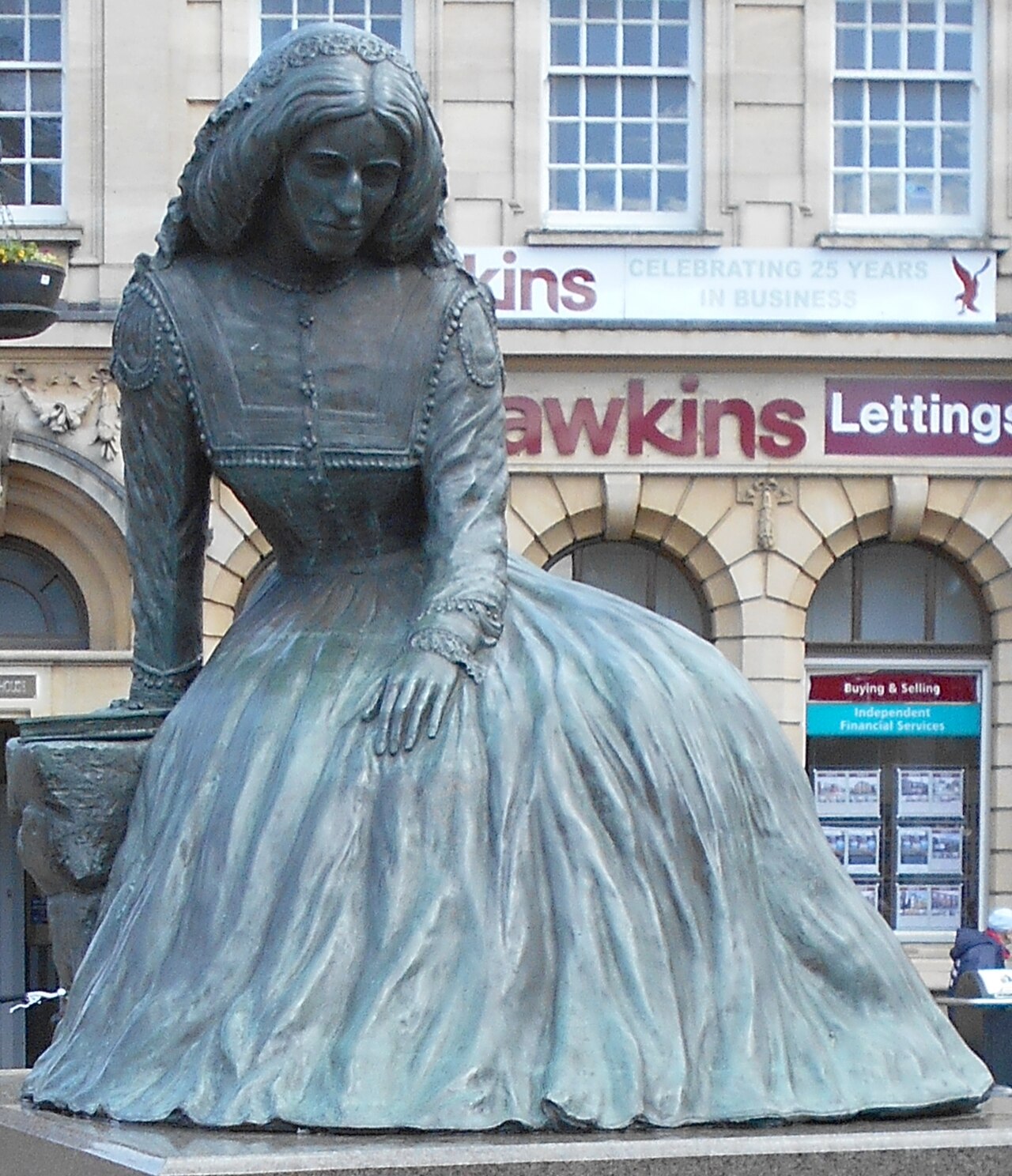
Eppie’s decision is one of a multitude of moral choices made by the characters populating the extraordinary suite of novels written by George Eliot (born Mary Anne Evans, 1819; died Mary Ann Cross 1880). Her novels include Adam Bede, 1859; The Mill on the Floss, 1860; Silas Marner, 1861; Middlemarch, 1871-2; Daniel Deronda, 1876. Standing with Dickens and Trollope in the triptych of great 19th century English novelists, Eliot’s breathtaking range of publications encompassed novels, poetry, literary criticism, translations, and scientific and religious essays. She was the most powerful female English intellectual of her age. Praise abounds for the quality of her fiction – for her plotting and drama, her descriptiveness, her characterisation, her use of language and metaphor, her ear for accent and dialogue, her humour, her psychological sensitivity and her philosophical exploration. Virginia Woolf described Middlemarch as “One of the few English novels written for grown-up people.” The novelist Thomas Keneally wrote recently that “No-one has ever out-thought or out-written her on human relationships.”
Eliot outlined her philosophy for fiction in The Natural History of German Life, 1856, published in the prestigious and progressive Westminster Review that she edited in all but name. Reflecting her intimate knowledge of the work of Auguste Comte, the ‘father of sociology’, and Ludwig Feuerbach, the German philosopher and anthropologist, Eliot signalled her intent to write a natural history of ordinary people in a spirit of humanist realism – a revolutionary departure for English fiction.
The world she chose to evoke was rural and small-town middle England, the world she knew so well as the daughter of a land agent in “the rich, fat country” outside Nuneaton in the West Midlands. The sub-title of Middlemarch is A Study of Provincial Life. She set most of her novels in this vista in the late 1820s/early 1830s. Her contemporary readers would have remembered it from their childhood, depicted in its entirety, whilst also noticing the emergence of the economic, social and political forces that transformed English society in their lifetimes. Forces for change that were manifested in Eliot’s characters – for instance, Dorothea Brook’s vision for transforming the landowner-tenant relationship; Lydgate’s passion for modern, preventive medicine; Ladislaw’s embrace of political reform at the time of the Great Reform Act of 1832; Silas Marner’s discovery in later life that the Lantern Yard chapel of his youth had become “a large factory, from which men and women were streaming for their mid-day meal”; and the ghost character, money, that permeated all her novels as materialism took hold in the 19th century.
Eliot’s novels are not, however, exclusively of the outer world. DH Lawrence called her the first novelist to put all the action inside. She takes us confidently into the inner world of her characters, describing their motivations, emotions, fears, addictions, aspirations and attractions, often in highly embodied ways. Such was her success in taking on the “Hard task to analyse the soul” (William Wordsworth, The Prelude: Book 2, 1805 – he was much admired by Eliot), that modern observers remark on her capacity to articulate psychoanalytical ideas well before they were current. In her study of her characters’ inner life, we hear echoes of Baruch Spinoza, whose Ethics (1677) Eliot translated from the Latin in 1856. As the philosopher Clare Carlisle elucidates, Eliot’s strong affinities with Spinozism include “…the deep emotional intelligence evident throughout her novels… and her core sense that human excellence lies in enlarging the human soul.”
Eliot lost her evangelical faith in her early 20’s (to avoid the risk of family breakdown, she compromised with her father, attending church with him but not taking communion). But she did not abandon the code of ethics, allied with a deeply felt inner life, that she had developed in her school days. Described as a humanist, Eliot’s spiritual philosophy was much influenced by Comte, by Feuerbach’s The Essence of Christianity (1841), and by David Strauss’ The Life of Jesus, Critically Examined (1835), both of which she translated from the German. For her, the essences of Christian belief and practice must continue but in a secularised way. Eppie’s salvation of Silas is one of many examples – the little child leading him to the only kingdom of heaven that Eliot would allow on earth, compassionate community.
Character development – evolution if you like – is at the core of Eliot’s universe, her narrator navigating her characters like seas of consciousness, long journeys through time. We are invited to a whole life view – Maggie and Tom Tulliver, siblings in The Mill on the Floss, heartbreakingly repeating relationship patterns from early childhood to their death by drowning in each other’s arms in early adulthood; Silas Marner, from evangelical youth to complete loss to isolation to contented old age; Dorothea Brook from late teens through her desiccated marriage to Casaubon to her love of Ladislaw, all the while seeking ways to satisfy her aspirations to change the world for the better; the list goes on, much lost, much gained in individual lives. Throughout, we sense Eliot’s belief that we are all capable of spiritual growth, our own version of the passion and crucifixion, but that we cannot do it alone, we must be sympathetically open to what our fellow human beings can give us. We also need will and determination, ‘Endurance’ in Eliot’s lexicon. Here is Dorothea in Middlemarch looking out one morning as the local community moved off into their working days – “Far off in the bending sky was the pearly light; and she felt the largeness of the world and the manifold wakings of men to labour and endurance”.
Eliot’s humble grave in Highgate Cemetery is a perfect place to contemplate her own extraordinary trajectory of the life of the mind, or the life of the spirit as she herself articulated it. Biographers agree that her passion to make an intellectual difference in the world ignited in her encounters at school with spirited, independent female teachers; developed in her studies in her father’s client’s grand library and with the tutors he provided for her; evolved in her contact with a community of free-thinkers and radicals in nearby Coventry; and then flowered in London and abroad, in a plethora of intellectual endeavours, drawing support from her ‘shared soul’ romantic and intellectual partnership with George Henry Lewes (1817-1878). Her trajectory to intellectual pre-eminence was not without its squalls – she experienced a lull in popularity in the 1860’s before she wrote Middlemarch, and she constantly sought reassurance about the quality of her writing – but it was always fuelled by profound determination, her own endurance. Here from her journal is a full day even by her standards, 13 June 1855 – “Began Part IV of Spinoza’s Ethics. Began also to read Cumming for article for Westminster Review. We are reading in the evenings now, Sydney Smith’s letters, Boswell, Whewell’s History of Inductive Sciences, the Odyssey and occasionally Heine’s Reise Bilder. I began the second book of the Iliad in Greek this morning.”
A perfect place too, her graveside, to reflect on her final words in Middlemarch, encapsulating Eliot’s democratic spirit, her admiration of ordinary lives, and her profound belief in human potential and the scope for improvement:
“But the effect of her being on those around her was incalculably diffusive; for the growing good of the world is partly dependent on unhistoric acts; and that things are not so ill with you and me as they might have been, is half owing to the number who lived faithfully a hidden life, and rest in unvisited tombs.”
George Eliot – the effect of her influence, art and wisdom “incalculably diffusive” through the ages.
Related posts:


Image References
By WikimediaCommons | CC BY PD
Permissions required for the publishing of this article have been obtained
Article References
In Our Time, Middlemarch, BBC Radio. April 2018 In Our Time, Silas Marner, BBC Radio. January 2010 Spinoza’s Ethics - Translated by George Eliot, edited by Clare Carlisle. Princeton University Press, 2020 The Marriage Question; George Eliot’s Double Life, by Clare Carlisle. Penguin Books, 2024 Inside Lives, Psychoanalysis and The Growth of the Personality, by Margot Waddell. Routledge, 2019
What do you think?