The Bhagavad Gita and the Inner Battle
Article By Siobhan Farrar
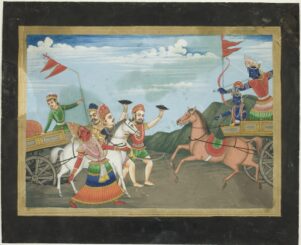
Arjuna Slays Karna, Page from a Mahabharata Series
More:
Original public domain image from Art Institute of Chicago
The Bhagavad Gita is a philosophical treasure of the Indian wisdom tradition. A heroic tale which for the wisdom-seeker explains many spiritual truths about ‘the inner battle’ and the human condition. The name ‘Bhagavad Gita’ means ‘Song of God’.
The story is about two branches of a single family descended from brothers Pandu and Dhritarashtra. Dhritarashtra, the eldest son, was born blind (symbolically without spiritual vision), so it was impossible for him to be his father’s heir. The second son, Pandu, had a different problem in that he couldn’t have children, but using a special mantra his wife called forth the Gods, asking each in turn to father a child with her on her husband’s behalf. With this the ‘Pandavas’ – sons of Pandu – were born, becoming the rightful heirs to the kingdom. The wife of Dhritarashtra also became pregnant, but her pregnancy lasted for many years and, lamenting her state, she requested to be hit on the stomach to bring forth the child. She gave birth to an iron ball which shattered into 99 pieces that became the sons of Dhritarashta, the ‘Kuravas’.
The Pandavas and Kuravas represent the two principal aspects in man and the two directions of man’s activities. First, the Pandavas represent our spiritual aspect coming from above, symbolised by parentage from the Gods; they show the direction of our qualities, our acts of goodness and in short our virtues. The second aspect, the Kuravas represent our material nature symbolised by the iron ball and multiplicity. This is the direction of our egoistic tendencies and self-interest, in short our weaknesses. Human beings are both, part spiritual and part material, and we all share the task of learning how to live and act in both worlds. It seems that the dichotomy between spirit and matter is the condition of our consciousness, but the eternal question (which the Bhagavad Gita addresses) is which of these two aspects will guide our consciousness and therefore our lives? It seems that we are required to make that choice.
The kingdom is called Hastinapura ‘The City of Elephants’. The elephant is associated with the ideal of the sage who possesses immense strength to surmount any barriers, but with such gentleness that, were a trail of ants to cross its path, the benevolent creature would carefully lift its feet to avoid stepping on any of them. Hastinapura represents our consciousness, where the two principal families (two aspects in the human being) contest the rulership. The Pandavas are the rightful rulers, but the eldest son Yudhishthira lost a loaded game of dice and, as forfeit, the Pandavas were exiled for 12 years, with the Kuravas ruling in their absence. After the relevant time had passed, the Pandavas returned, but having decided they quite enjoyed being in charge, the Kuravas refused to give up their position. We too often gamble away our responsibility and self-governance (just this once, it can’t hurt, one more roll of the dice…) and in place of our virtues, self-discipline and fortitude, our vices happily take charge.
After unsuccessful attempts to resolve the dispute by negotiation, it becomes clear that a battle will be inevitable… Arjuna, leader of the Pandavas and hero of the story goes with Duryodhana, leader of the Kuravas to consult their cousin Krishna. Sleeping when they arrive, Krishna awakes, listens to them and explains that, to one he will offer all his armies and to the other he will offer himself. Having seen Arjuna first as he awoke, Krishna asks Arjuna to choose and, without hesitation, Arjuna chooses Krishna. Duryodhana is secretly thrilled because given the option he certainly would’ve opted for the armies!
Krishna represents the spark of divinity in each person and also divinity in the most universal sense. By choosing Krishna, symbolically Arjuna chooses the counsel of his own spirit, he chooses Life in its profoundest aspect and chooses wisdom to be his guide on the battlefield. By contrast, our egoistic nature, symbolised by the Kuravas will always choose massification, accumulation, quantity and variety. It will alway seek breadth over depth and this is why negotiation with our weaknesses is rarely possible. Our lower drives cannot conceive of things beyond their own nature, our material self cannot imagine our spiritual self because, just like Dhritarashtra, matter is born ‘blind’ and without spiritual vision.
Following the meeting with Krishna, the battlefield is set and the armies of the Pandavas and Kuravas line up on either side of the Kurukshetra, the battlefield of life. It falls to Arjuna to fire the signal for battle to commence, but as he rides up and down between the two armies with Krishna as his charioteer, he is utterly overcome by fear and despair… Why must he fight?! He drops onto the chariot floor refusing to fight – it is the image of the crisis at the centre of the human being: a crisis which appears inevitable in the development of our consciousness in its ascending movement
Arjuna’s point of indecision, his uncertainty and doubt loom like a perilous expanse but in his despair he makes a decision to ask Krishna for help and it is now that Krishna begins to sing to him. Arjuna represents our heroic nature, the attitude that wants to bring out the best we have within for the benefit of those around us. We all possess this heroic spark and however dim it may seem during times of crisis, one of the first lessons for the hero to learn is that it is necessary to move into action. Arjuna demonstrates this movement out of despair by asking Krishna for help.
In our own lives, once we accept a situation and take some action, we begin to feel immediately freer. Often the point of acute fear is not in the event itself but the anticipation of it. Once we begin to test ourselves and get to know ourselves we feel ourselves a little lighter. If we are aware in a crisis then such crises can prove to be the most transformative moments of our lives.
As Krishna begins to sing, he teaches Arjuna about reincarnation and the idea that there is an essential part of the human being which is immortal: “Nothing that truly exists can ever die”. We may not personally believe in reincarnation but most of us can sense a kind of centre within which we have greater stability and are less changeable compared to more transient whims and shifting moods. Our centre is where we encounter feelings of peace, solemnity and serenity. We are better able to accept and understand Life as it IS, and be less thwarted by the vagaries of circumstance.
In the conquest of ourselves and the living of a full life, it is essential that we provoke a conflict between these two aspects of our human nature. Why? Because in one sense it is through the inner battle that our heroic part can realise its potential and might seize the opportunity to build internally and externally. It is the same in our inner world as it is for our outer world: everything known to us at some point wasn’t, we will have had to have entered into the unknown to discover it. The Bhagavad Gita describes the evolutionary human need for the inner war. What’s more, knowing this battle within ourselves we will have far less recourse to external wars and battles with each other. The message of The Gita can help to liberate the heroic potential we have within and its symbolism can support us in facing our daily struggles, so like Arjuna we can ascend towards the heights of our consciousness and govern our lives with wisdom.
Image Credits: By Rawpixel | CC0 1.0
Related posts:

Image References
By Rawpixel | CC0 1.0
Permissions required for the publishing of this article have been obtained
What do you think?