Beethoven and The Sublime
Article By Julian Scott
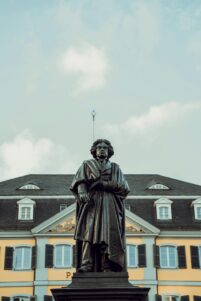 Reading about the life of Beethoven reminded me of what was said of the Sumerian hero Gilgamesh, that he was two-thirds divine and one-third human, and that his human part made him a very difficult character to live with. If you listen to Beethoven’s music – the ‘Eroica’ (3rd) Symphony, the ‘Emperor’ (5th) Piano Concerto, the ‘Pathétique’, ‘Appassionata’ and ‘Moonlight’ sonatas, to mention but a few of his most famous works – you may be able to recognize that ‘divine’ part of the composer. And if you read John Suchet’s trilogy on the life of Beethoven[1], or any biography of Beethoven, you will see that human side which could at times be insufferable, even to his closest friends. In this article, I will look at both these aspects and consider what it tells us about art, the artist, idealism, humanity and life in general.
For those unfamiliar with the man and his music, here are a few details about his life and work.
Ludwig van Beethoven was born in 1770 in Bonn, on the banks of the majestic River Rhine, and in the shadow of the Drachenfels mountain, where the legendary battle between Siegfried and the dragon is said to have taken place. From his earliest years, the young Beethoven was strangely attracted to it and admired its craggy and towering presence, perhaps in anticipation of the elemental power of the music he would later create.
He was a ‘different’ child, which his grandfather, also Ludwig, chief court musician (Kappelmeister) at Bonn, recognized as marking out a great musical destiny, but which disturbed his parents, especially his dissolute father, also a court musician, but one who wasted his talents in the local taverns. As he ran out of money, he decided to train his son as a child prodigy, like Mozart, and used to come home from the pub in the early hours of the morning, wake him up and force him to practise for hours on end. Ludwig also stood out as different at school and suffered on this account as well.
What helped him deal with all this adversity in childhood was a very determined, even obstinate, will, and the conviction that he was destined to become a great musician. He was also inspired throughout his life by the memory of his grandfather, who died when he was only three or four, but who treated him with special respect and affection.
He was equally determined not to be a court musician, but to make his own way, as Mozart had to some extent. As soon as he could, he managed to make it to Vienna, the musical capital of Europe at the time, where he had a brief meeting with Mozart, who taught him an unforgettable lesson: “the simple themes are the best”. It is interesting to see how, if someone is receptive, a short meeting and a single teaching can accompany them for the rest of their life, becoming a lasting influence. You can hear an example of one of these simple themes in the Adagio (2nd movement) of his Pathétique sonata.
In Vienna, he began to receive the patronage of several aristocrats, such as Prince Lichnowsky, Prince Lobkowitz and Archduke Rudolph, the Emperor’s brother.
He had a love of ‘Liberty, Equality, Fraternity’ – the ideals of the French Revolution, and it was for this reason that he was initially a supporter of Napoleon, who at the time was conquering the rest of Europe. He saw the ‘humble Corsican’ as ushering in a new age that would sweep away the injustices of the class system and lead to a world where ‘all men shall be brothers’, as the lyrics of the Ode to Joy at the end of his 9th Symphony say. But when Napoleon had himself crowned emperor, Beethoven became disillusioned and withdrew the dedication of his 3rd Symphony to ‘Bonaparte’, dedicating it instead to Prince Lobkowitz.
He was always happiest in the company of musicians, with some of whom he would drink at a tavern called The Swan. Several of his friends helped him in his musical labours and in the practical aspects of his life, but he was often rude and overbearing both to them and to his long-suffering servants and landlords, whose tenants would often complain about his habit of playing the piano and stamping about in the middle of the night.
A turning point in Beethoven’s life came when he was staying in Heiligenstadt, a small town outside Vienna, where he had gone to compose. It was there that he came to the realization that he was becoming increasingly deaf, a fact which plunged him into despair, above all because of its implications for his music. Indeed, he soon became incapable of performing or conducting. But the worst did not happen: he could still compose because he could hear the music in his head and write it down. Eventually, he didn’t even need the piano to compose any more.
In the depths of his despair he wrote his Last Will – the so-called Heiligenstadt Testament, most of which is not about the disposal of his meagre assets, but about his love of humanity, and how he was misunderstood as being a ‘misanthrope’ (a hater of mankind), which he attributed to his deafness, which made him avoid the company of others because he could not communicate with them.
I would now like to look at the contrast between his sublime music and his often dreadful character. I wondered several times while reading about his life why his friends and patrons put up with him and seemed not only to admire his music, but to have had a genuine love and affection for him, despite his frequent rudeness, unreasonableness and sometimes even cruelty. I came to the conclusion that it was because they could see that Beethoven’s sublime music was a true expression of his own soul, a soul that was full of beauty and love for humanity. Knowing him well, they could see through his rough exterior to the better self within and so forgave him his many faults.
After meeting Beethoven, the poet Goethe wrote to his wife: “Today I met the composer Beethoven. A more ardent, spirited, profound artist I have never met. I can fully understand why the world marvels at him so.” The next day, after a further meeting, he wrote again: “Beethoven’s talent amazes me. He plays exquisitely. But unfortunately he has an absolutely uncontrolled personality. Admittedly he is not wrong in finding the world detestable, and yet by so doing he does not make it any more pleasant either for himself or for others. At the same time he deserves to be greatly forgiven and greatly pitied, for his deafness is increasing…”
I think Goethe expresses it well. Some geniuses, like Goethe himself and the composer Haydn, were very well-rounded individuals. Others, like Beethoven, were not. Again, we come back to the ‘two-thirds divine and one-third human’. Regarding the human part, some deal with it better than others, and some are faced with more difficult circumstances in life.
What did Beethoven think of his fellow genius, Goethe? Here is his somewhat scathing comment to his publisher, after he had seen Goethe bowing to the Empress (which he himself refused to do): “Goethe delights far too much in the court atmosphere, far more than is becoming for a poet. How can one criticize other virtuosi in this respect when even poets, who should be regarded as the foremost teachers of the nation, can forget everything else when confronted with that glitter?”
As regards his music, I have used the word ‘sublime’, because I think it encapsulates its quality. Beethoven had many troubles in his life apart from his deafness, from frustrated love affairs to family problems and many others. But in my view, none of this comes through into his music. Rather, when he was composing, he ‘escaped’ from his problems and his character. He went to be with his soul. He went to a ‘musical heaven’ where he heard the music which he then transposed into his works.
Thus we can hear in his music all kinds of emotions, but all of them are devoid of any baseness or impurity. There are heroic, noble emotions, there is beauty, mystery and even magic; there is tenderness, love in its highest sense, images of gentle streams or violent storms, and there is also joy, vigour and cheerfulness.
This music, which was offered as a gift for humanity from the higher part of Beethoven’s soul, has indeed had a transformative effect on thousands, perhaps millions of human beings. At a certain point in his 5th Symphony (the one with the famous opening), a veteran old soldier stood up spontaneously, unable to contain himself, and cried out “Long live the Emperor!” (It was the time after the liberation of Vienna and the defeat of Napoleon). And many individuals have written about how Beethoven’s music has literally saved their lives, because of its message of triumph over adversity.
The founder of New Acropolis, Jorge Livraga, once wrote that “art without a message is like an envelope without a letter”. So what was Beethoven’s message? In his own words, he said (according to Suchet): “my music teaches what life is about”. This may seem a bit vague from a rationalist perspective, but it is really very profound. Life cannot be put in a box, but it IS, and it is everywhere and in everything. He was not just referring to physical life, or even energy. As David Suchet has Beethoven say at some point “I am not describing nature, I am creating it in sound.” And elsewhere he says: “It’s not just the notes themselves, it’s what lies behind them.” Similarly, life is not just physical nature, it is what lies behind it. So when he writes the ‘Pastoral’ Symphony (No. 6), for example, he is not imitating the sounds of birdsong with the flute or piccolo, he is transmitting to us what is behind those sounds. Plato criticized ‘imitative art’ and I think Beethoven would have agreed with him. He did not imitate, he created – with the help, as he himself admitted, of his ‘muse’ – one of those muses that the ancient Greeks pictured as the nine followers of Apollo, the great god of music and beauty, or the Hindus symbolized in the form of the heavenly Gandharvas.
None of us can compose music like Beethoven’s, but thanks to his heroic efforts to give form to what was inside him, we can all travel to the land of the soul and experience the beauty, mystery, magic, glory and serene joy of that ‘musical heaven’.
Image Credits: By Radwan Menzer | Pexels | CC BY PD
Related posts:

Image References
By Radwan Menzer | Pexels | CC BY PD
Permissions required for the publishing of this article have been obtained
Article References
[1] The Last Master: a fictional biography of Ludwig van Beethoven, by John Suchet. Warner Books, 2000.
What do you think?