The Eternal Mystery of the Count of Saint Germain
Article By Laszlo Balizs
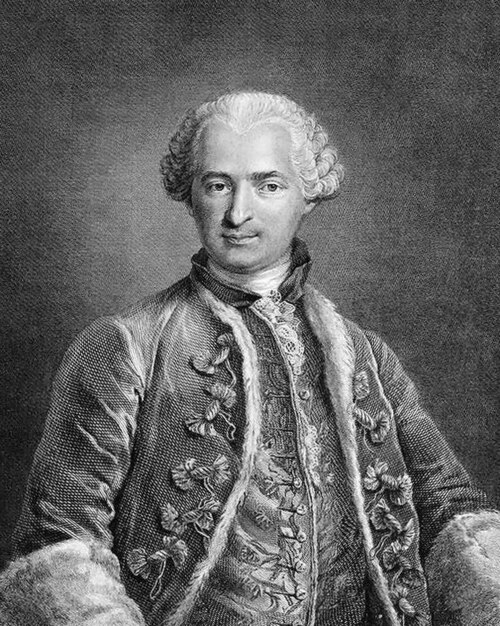 In the glittering salons of eighteenth-century France, stories circulated of a man who seemed to live beyond the boundaries of ordinary life. In one of them, the story starts with a diamond.
A jeweller once presented to Louis XV a brilliant stone with a blemish. The Count of Saint Germain, the enigmatic wizard already a court favourite, begged to be allowed to take the gem back to his laboratory. He returned hours later and placed the jewel into the king’s hand. The flaw had vanished.
No one could explain how he had accomplished it. Whispers circulated that he had invented a method of fixing diamonds, some said even making them. Still others believed it a parable that Saint Germain’s true gift was transformation: the power to perfect what was broken, to reveal hidden wholeness.
Exploring the life of the Count of Saint Germain is a plunge into history and myth, science and esotericism, politics and poetry. He is not easily contained.
Helena Petrovna Blavatsky, the co-founder of the Theosophical movement, once declared: “The Count of Saint Germain was evidently the greatest adept Europe has seen in centuries, though Europe never truly knew him.”
He was praised by kings, distrusted by ministers, admired by philosophers and remembered by ordinary men and women as the most extraordinary character they had ever met. Voltaire (1694 – 1778) said with irony: “He is a man who never dies, and who knows everything.”
Who was this man who dazzled courts and confounded spies? His birth and beginnings are shrouded in mystery. Some said he was Portuguese, others claimed Spanish or Venetian. He only furthered the mystery himself, making vague references to a noble line that he refused to specify.
One enduring theory ties him to Hungary. Géza Supka, the Hungarian aesthete, argued that Saint Germain was the natural son of Francis II Rákóczi (1676 – 1735), the great prince of Transylvania and leader of Hungary’s independence struggle against the Habsburgs. According to this story, the child was born in Italy during Rákóczi’s exile and throughout his life travelled under the name “Tzarogy”, an anagram of Rákóczi.
Saint Germain first appears in public records in London in 1745, when Britain was rocked by the Jacobite rebellion. He was arrested on suspicion of being a Jacobite operative and questioned by the Duke of Newcastle.
Horace Walpole, writing to Horace Mann on 9 December 1745, described him vividly: “They arrested a curious man who goes by the name of Count St. Germain. He has been here for two years, and no one knows who he is or where he comes from. He says his name is not real, that he has never had to do with women, sings, plays the violin exquisitely, and composes… People call him Italian, Spanish, Polish… the Prince of Wales is endlessly curious about him, but in vain.”
Released without charge, he soon turned to music. Charles Burney, historian of music, remembered him as a composer of Six Sonatas for Two Violins (1747) and Seven Solos for a Violin (1758). He was celebrated as an improviser and virtuoso, a figure who helped define London’s musical life.
In 1757, Saint Germain appeared in Versailles, where Louis XV was recovering from an assassination attempt. He soon earned the confidence both of the king and Madame de Pompadour. He dazzled courtiers with his diamonds, his grasp of science and his attitude of seeming indifference to personal gain. Mme du Hausset, Pompadour’s maid, recalled: “He dressed simply but with taste, wore magnificent diamonds on his fingers and snuffbox, and amused himself by letting people believe he had lived for centuries.”
Louis XV granted him apartments at Château de Chambord, where he set up laboratories. There in his workshop he experimented with dyes, pigments and medicines, offering them freely for the prosperity of France. His vision was that new industries would employ workers, alleviate poverty and strengthen the kingdom.
But enemies gathered. The powerful minister Choiseul, jealous and suspicious, spread rumours against him. In 1760, Saint Germain was exiled.
Saint Germain travelled to the Dutch Republic, staying with the wealthy Hope brothers of Amsterdam, directors of the East India Company. There he was an informal diplomat, attempting to mediate peace between France, Britain and Prussia during the Seven Years’ War. Prussian envoy Bruno von Hellen wrote to Frederick the Great on January 3, 1760: “A kind of adventurer… he whispers behind the scenes and plays an important role at Versailles. He seems to have persuaded the king that he can produce the philosopher’s stone.”
He socialized at the highest levels in The Hague and Amsterdam. But suspicion escalated; pamphleteers ridiculed him as a schemer dabbling in finance and diplomacy. By late 1760, under pressure from Choiseul, he fled once more.
The image remains of a man trusted by none, courted by all, forever walking the line between diplomat and outcast.
By the 1770s, Saint Germain found refuge with Prince Charles of Hesse-Kassel. There he lived as a philosopher and not a courtier. He dressed simply, lived economically and gave freely to the poor. He became known for his remedies – especially the Thé de Russie (Russian Tea) – and for his teachings about harmony between body and soul. He was a model of moderation, drank only water or tea and followed a mainly vegetarian diet.
According to official records, Saint Germain died in Germany on 27 February 1784 under the care of Prince Charles of Hesse-Kassel. He was buried in the parish church of St. Nicolas. Yet almost immediately, rumours began to circulate.
He was observed in 1785 attending a Masonic meeting in Paris. In the years that followed, Madame de Genlis would claim to have seen him again, not a day older. In Venice, in Milan, in Germany, whispers of his presence continued.
Perhaps, the greatest mystery of Saint Germain is not whether he truly conquered death, but why his story refuses to die. He is the archetype of the Eternal Wanderer – a man who belongs to no time, no nation and no single destiny. His legend persists because he embodies the universal human task: to seek transformation, to live for something greater than ourselves and to walk the path of wisdom without end.
And so, in truth, Saint Germain never left us. He lives wherever we choose to transform what is broken into wholeness, to serve without thought of reward and to look beyond ourselves toward the eternal.
Accounts of Saint Germain agree on one theme: his life was characterized by benevolence, integrity and a sense of mission. He never sought reward. He offered his discoveries in chemistry, dyeing and medicine freely, asking only that they serve the public good. He frequently discussed the harmony between body and soul, believing that when this balance was achieved, “the machinery of life cannot fail.”
Prince Charles of Hesse-Kassel, who knew him intimately, remembered him with reverence: “Perhaps he was the greatest philosopher who ever lived. A friend of humanity, he only desired money to give it to the poor. His heart was never filled with anything but doing good for others.”
But his influence went far beyond private acts of generosity. Saint Germain moved between societies and brotherhoods – the Rosicrucians, Freemasons, the Asiatic Brethren, and the Knights of Light – guiding, teaching and linking them in dialogue. Isabel Cooper-Oakley[1] remarked that he “passed from one society to another, pointing the way, teaching.” He was travelling from lodge to lodge, forging unity among them at a time when divisions threatened to break them apart. In this, he was not only a solitary sage but a builder of bridges between kingdoms, between esoteric orders, between fragments of knowledge scattered across Europe.
The practical work he did was revolutionary. Jean Overton Fuller[2] suggested that his perfected methods of dyeing silks, leathers and fabrics – brilliant colours produced at low cost – prefigured the industrial revolution by more than a century. By providing employment to the poor and offering affordable goods to ordinary people, he helped to diminish the divisions of class and wealth. His vision was not just alchemical but social: to transmute suffering into prosperity, exclusivity into access, despair into dignity.
Viewed in this light, Saint Germain was more than a cryptic nobleman or wandering alchemist. He was a force of renewal, a man who lived to give, to unify and to lift humanity closer to its hidden potential. His myth lives on, not just because of what he knew, but because of what he attempted to awaken in others: a greatness beyond the self, rooted in service, harmony and the endless work of transformation.
[1] Cooper-Oakley, I. The Comte de St. Germain: The Secret of Kings. Theosophical Publishing Society, London, 1912.
[2] Fuller, J. The Comte de Saint Germain: Last Scion of the House of Rakoczy. East-West Publications, London, 1988.
Related posts:
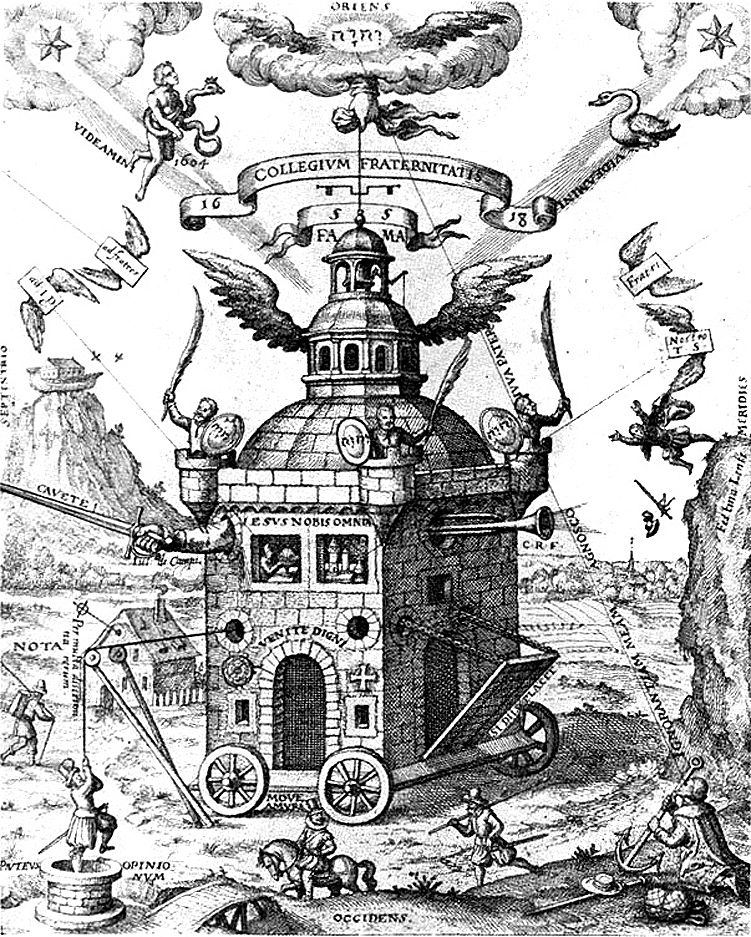

Image References
By WikimediaCommons | CC BY PD
Permissions required for the publishing of this article have been obtained
Article References
Blavatsky, H. P. Collected Writings. Theosophical Publishing House, Wheaton, 1966–1991. Blavatsky, H. P. The Theosophical Glossary. The Theosophical Publishing Society, London, 1892. Cadet de Gassicourt, C. Le Diable amoureux, ou Vie et aventures du Comte de Cagliostro. Paris, 1791. (Mentions contemporaries including Saint Germain). Cooper-Oakley, I. The Comte de St. Germain: The Secret of Kings. Theosophical Publishing Society, London, 1912. Fuller, J. (for portraits) The Comte de Saint Germain: Last Scion of the House of Rakoczy. East-West Publications, London, 1988. Pratt, D. The Comte de Saint-Germain. David Pratt, online publication, 2004. Supka, G. Az arany urai és rabjai. In Nemesfémipari Évkönyv, 1934. (Hungarian) Voltaire, F. M. A. Correspondence and Selected Writings. Various editions; his quip on Saint Germain is often cited in 18th-century correspondence, c.1760. Walpole, H. & Burney, C. References to Saint Germain in Letters and History of Music respectively (London, mid-18th century). Walpole, H. The Letters of Horace Walpole. Ed. Mrs. Paget Toynbee, Clarendon Press, Oxford, 1903.
What do you think?