Towards Unity Through Diversity (Part 1)
Article By Fernand Schwarz
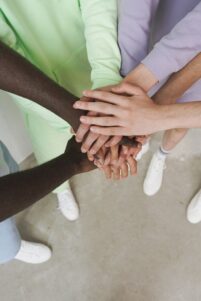 We know from systems theory or evolutionary ecology that the degree of greatest development of a system[1](an ecosystem, for example) is defined by its level of diversity, which is strongest in the face of changes and distortions when it is at its highest level. All the species that form part of the system contribute to its stability, and its unity depends on the countless links established within its diversity.
We find this axiom in any organization in Nature: family groups, herds, towns, communities of species, etc.; and on an individual level in the organization of an organism, a cell, the genetic material.
This axiom also applies to the systems achieved by human beings in the course of their evolution (“unity depends on diversity”): when a system approaches its maximum diversity it attains its greatest stability and degree of development, and exhibits a more robust unity than when it is further away from its potential diversity. In this way, societies, family clans, symbolic groups or commercial networks, to mention some systems that can be counted among the evolutionary achievements of the human being, exemplify this axiom. For example: a society with a greater diversity of professions and job types is more stable and developed, a health system with more specialists and equipment is more efficient in preserving health, a set of laws with more normative developments is more capable of responding to varied circumstances. This applies in these and many other cases, provided that the parts have links between them and are orientated towards a unity, such as the common good.
In other words, just as no species is superfluous in a material ecosystem, so no individual is superfluous in a society, no knowledge in a university, no expression of beauty in a centre of art, and no plan in the building of the future.
What is appropriate for the human being as an individual and in relation to his cultural, symbolic and economic creations, is that the dependent relationship between unity and diversity should be maintained. When this relationship breaks down, there appear individuals with excessive egos, cultural exclusions, massified societies, totalitarianism. And on a personal level, the loss of balance between unity and diversity gives rise to addictions, manias, phobias or the loss of health.
This axiom, which until now has only referred to material projections, is equally valid in the psychological, mental and spiritual fields, and in the interactions between these planes themselves and with the material plane.
For the philosopher Edgar Morin, the real and effective constitution of a planetary humanity should involve at the same time the full achievement of human unity and diversity. He was of the opinion that unity cannot be separated from diversity and variability, since “what characterizes the organization of the system homo (species/individual/society) is that it can generate – by its fundamental and, therefore, “constant” characteristics – great varieties of behaviours, strategies and social relationships.”[2]
The unity and the humanity to which people aspire should not consist in a destructive and phagocytic uniformization and homogenization of cultural and individual diversities and differences, but should be capable of welcoming diversities and singularities within itself. “Thus − we can conclude – as a highly complex animal, the human being is biologically determined by a principle of unity-diversity and, already at this level, unity and diversity are non-exclusive but complementary terms.”[3]
Anthropological universals are not only biological in the narrow, reductionist and biologicist sense of the term, but biocultural, and this biocultural unity cannot be separated from diversity and variability. The biological and socio-cultural aspects of the human being should not be conceived as two separate or merely juxtaposed dimensions. Morin is opposed to any reductionist construction of the concept of the human being, built one-dimensionally from a single perspective, whether this be culturalist or biologicist, because the human being is not biological on the one hand and cultural on the other, in a juxtaposed and alternative way, but constitutes a “holistic system”, a “complex organized unit”, constituted by a group of interactions and independencies between multiple and diverse bio-psycho-social factors. Human beings, then, must be defined in a “total” way, that is say “bio-psycho-social”, since we are the result of permanent interactions of this type.[4]
Humanity is one and diverse at the same time
Since its origins in 1957, New Acropolis has upheld the unity of humanity and its diversity as the basis of its own philosophy.
Jorge Ángel Livraga, the founder of New Acropolis, has said: “The human being carries within himself the archetypes of the whole of humanity. Each of us reflects, somehow, all the human beings who exist on the earth. Each of us has within himself all the dreams of those who have lived on the earth and also of those who will come in the future. Each of us has a truly unsuspected potential, but it is necessary to have tenacity.”[5]
“In this richness of humanity, each of us has our own way of feeling, our own way of thinking, our own way of living; but we all also have a culture that unites us. That culture that unites us allows us to speak about science, art, literature, and many other things, and we understand one another by conventional signs that we have accepted. In other words, human beings, in the genetic aspect, only inherit a series of instinctive abilities, but a learning process is also needed; that is to say, the transmission of culture is necessary for the human being to realize himself as such.” [6]
“History is part of Nature and will respond to the same laws of causality. Humanity forms part of the immensity of the Cosmos, of Nature. We are not a species of aliens, we are within Nature.”[7]
The International Organization New Acropolis (IONA) has continued with and developed the promotion and practice of the philosophical principles proposed by its founder, Jorge Ángel Livraga, as we can see from the resolutions and actions proposed at each of its General Meetings over the years.
In 2024 we celebrated 67 years of action in favour of unity in diversity, during which time we have forged a unique experience of harmonious coexistence, as demonstrated by the fraternal union within our movement of members from Hindu and Muslim backgrounds, Israelis and Palestinians, as well as members of many ethnic, religious and other minorities.
Our hundreds of thousands of volunteering hours in favour of people abandoned and marginalized by society − the homeless, immigrants, disabled persons, indigenous (or autocthonous) minorities, elderly people and others − bear witness to our commitment to diversity and to social, ethnic or cultural minorities. This unique and positive experience has made it possible to unite human beings in a fraternal way beyond their differences, and is a source of hope for the present and the future.
To promote union in diversity is to give life to the founding principle of the philosophy of living together: philia is the natural sympathy that unites all living beings, which Aristotle distinguishes from friendship between two people. It is the civic friendship founded on the inalienable consideration that each individual deserves. This attitude of human comradeship enables the circuit of violence to be broken. It is a powerful antidote to discrimination, marginalization, exclusion and therefore the advance of barbarism.
Unity and diversity are not about politics or society. They are above all philosophical, metaphysical concepts which refer to one of the essential laws of Nature, and their application is translated into many fields from the biological to the social, the cultural, the political, etc., as an effect.
Image Credits: By SHVETS production | Pexels | CC BY PD
Related posts:

Image References
By SHVETS production | Pexels | CC BY PD
Permissions required for the publishing of this article have been obtained
Article References
[1] Author’s note: From this point onwards, whenever I mention the term ‘system’ it will be to refer to any system in which there is a certain degree of complexity inherent in the connections between its constitutive elements.
[2] Morin, Edgar (y M. Piattelli-Palmarini) 1982 «The unity of man as an interdisciplinary foundation and approximation», in Leo Apostel et al, Interdisciplinarity and Human Sciences. Madrid, Tecnos/Unesco, 1983: 188-212.
[3] Morin, Edgar - 1973 The Lost Paradigm. Essay on Bioanthropology. Barcelona, Kairós, 1983 (3rd edition).
[4] Morin, Edgar 1982, ibid.
[5] Lecture: “How Dreams Become Reality”, in Magic, Religion and Science for the Third Millennium, Vol. III, Ed. Nueva Acropolis, 1995
[6] Lecture: Continuing Education for a New Formation, in Magic, Religion and Science for the Third Millennium. Vol. II, Ed. Nueva Acropolis, 1995
[7] Lecture: Beyond the Crisis, in Magic, Religion and Science for the Third Millennium, Vol. V, Ed. Nueva Acropolis, 1995
What do you think?