The Symbolism of Bread
Article By Michael Lassman
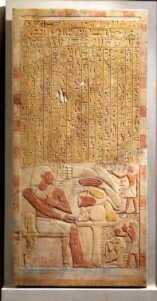
Stela of the Steward Mentuwoser, Middle Kingdom (ca. 1944 B.C.)
Bread is as old as civilization itself. Wherever humans learned to grind grain into flour, mix it with water and apply heat, bread emerged − not just as sustenance, but often as a symbol of life itself, of order, and at times, of connection with the divine.
Across ancient cultures, bread has always been a marker of identity, spirituality, and a social structure.
Dating back to when humankind first began its journey as hunter-gatherers, there is evidence to suggest a primitive form of bread-making existed, perhaps as long ago as 30,000 years; ground grains mixed with water and baked on hot stones.
In many cultures, bread stories emerged − in Ancient Egypt in 3000 BCE bread was considered a gift from Osiris, the god of grain and rebirth. In Mesopotamia, Gilgamesh enabled Enkidu to become human with the sharing of bread and beer. In Ancient Greece breadmaking became an artform with up to seventy still-known recipes. In Rome bread became politicized, as a hungry population meant revolt and a well-fed one meant peace[1]. In Persia, bread was linked to Zoroastrian purity laws and in Mesoamerica, maize breads were tied to the belief that humans were made of corn.
Today, every culture across the world shares in the daily taking of bread in one form or another.
More than Just Food – Ordinary and Sacred
Bread is the oldest known sign of devotion that we still hold in our hands.
It begins as dust and water, rises with invisible breath, and meets fire to become something new, surely alchemy in action. Over the centuries and across the world, bread has been the quiet companion of the sacred − a reminder that the divine often hides in the ordinary, waiting to be broken open and shared − a bringing together of communities.
We live in a world that moves at relentless speed, but bread (good bread) remains stubbornly slow. It asks us to pause, to work and to pause again. And in that waiting, something ancient can arise. Bread connects us to our ancestors, if we allow ourselves this thought, to our communities, and to the quiet mystical truth that nourishment is both physical and spiritual.
Bread is not just as food, it is a symbol, a ritual, and has the potential to be a philosophical and spiritual teacher.
The Elemental Miracle
Bread begins with the four classical elements, each one carrying its own spiritual resonance.
Earth provides for us the grain − the seed that holds potential, planted at sowing time, growing into the grain and harvested to sustain life. Wheat or barley, oats, corn or rye, every loaf begins in the soil, in the mystery of growth, supported by the quiet work of sun, aided by plenty of rain and the turning of the seasons.
Water binds the flour into something malleable, something with potential, capable of becoming. Water is the element of emotion, intuition and flow, and the movement of time itself. In breadmaking, the water awakens the dormant, softens the rigid and encourages the transformation.
Air enters through fermentation − the unseen breath energizes the dough. We can imagine how the ancient cultures saw leaven as a kind of spirit, a living presence that animated the mixture. Even today, watching dough rise feels like the witnessing of a little piece of magic.
Fire completes the metamorphosis. Heat transforms the living dough − and as the yeast reacts with the sugars in the grain, it is alive − into nourishment, finalizing the alchemical process. What emerges from the oven is no longer grain, water and yeast, but something entirely new.
Bread is a daily depiction of creation − a reminder that transformation is woven into the fabric of our existence.
Bread as Divine Gift
Across religious and spiritual traditions, bread appears not just as food but as a sign of divine presence, provision, care and community. A connection of people to the divine through ritual and practice.
Hinduism and Buddhism: bread as offering and simplicity
In Hindu practice, simple breads like chapati are offered as ‘prasad’, food blessed and shared with the divine. The act of offering transforms the ordinary into the sacred.
In Buddhism, bread embodies mindfulness − being aware of each hand that has been involved in its creation: farmer, miller, baker, and even of the earth itself. Eating the bread is in itself a mindful act, a representation of gratitude.
Judaism: bread as blessing
In the Hebrew Bible, bread is a symbol of partnership between humanity and the divine. The blessing recited before eating any food − “Blessed are You… who brings forth bread from the earth” − acknowledges that while humans bake the loaf, the earth itself is a gift.
Manna, the mysterious substance that sustained the Israelites in the wilderness, is described as appearing with the morning dew, resembling small loaves, tasting like honey, and arriving only in a portion of the size needed for each day’s sustenance. It was nourishment wrapped in a lesson: one of trust, gratitude and daily dependence on the divine spirit. Indeed, we still use the phrase “Manna from Heaven” as a descriptor for a much-needed gift.
Islam: bread as “rizq” — sustenance and respect
In many Muslim cultures, bread is treated with deep reverence. It is considered rizq, a form of divine provision. Dropped bread is lifted from the ground and kissed. To waste bread is to disregard a blessing.
Bread becomes a daily reminder of gratitude and humility.
Christianity: bread as presence and communion
Bread reaches a profound symbolic expression in Christianity. At the Last Supper, Jesus breaks bread and says, “This is my body, given for you.” For Christians, the Eucharist bread becomes a meeting point between the human and the divine − a rite of remembrance, unity and spiritual nourishment.
The Lord’s Prayer echoes the ancient plea for sustenance: “Give us this day our daily bread.” Here, bread represents everything we need to live − physically, emotionally, spiritually.
The Symbolism and Alchemy of Transformation
Breadmaking is a spiritual practice disguised as a recipe.
Kneading: the work of letting go − Kneading is physical prayer. It requires presence, rhythm and surrender. The dough resists, then softens. It teaches patience and the art of working through resistance − both in dough and in ourselves. What is important should not come to us easily.
Rising: the wisdom of waiting − Fermentation cannot be rushed. The dough rises in its own time, not ours. In a culture obsessed with immediacy, bread invites us into the sacred rhythm of waiting. Growth happens in the quiet, unseen places. Taking the opportunity to stop, contemplate and allow a time for spiritual growth.
Baking: the fire of transformation − Heat changes everything. What enters the oven is not what emerges. Bread teaches that transformation often requires intensity − the fire of challenge, the heat of experience. Yet the result is nourishment. We can acknowledge that the fire symbolizes the divine spark that is within each of us.
Sharing: the completion of the ritual − Bread is not complete until it is shared. A loaf eaten alone is only food; a loaf broken with others becomes something more, a ritual. The importance of creating a community with which to share is part of our journey.
Breadmaking takes us through a spiritual journey of effort, transformation and offering.
Bread as Community and Communion
Bread has always been a social food. To break bread is to welcome, to reconcile, to celebrate.
In ancient cultures, sharing bread sealed agreements and forged alliances. In many traditions, bread is the first thing offered to a guest − in restaurants we are welcomed at table with a bowl of bread. In times of conflict, bread becomes a symbol of peace.
Even today, a table without bread feels incomplete. Bread gathers people. It softens conversation. It creates space for connection.
In a fragmented world, bread reminds us that we belong to one another.
The Ordinary to the Extraordinary
Perhaps the greatest spiritual lesson of bread is this: the divine is not elsewhere. It is here, in the everyday, in the simple, in the humble and within us all.
Bread is made of almost nothing − flour, water, salt − yet it becomes something extraordinary. It teaches that the sacred does not require extravagance. It requires attention, a call to be mindful, conscious and aware.
In the baking of bread, we are at one with creation.
In the breaking of bread, we acknowledge its part in our sustenance.
In the sharing of bread, we affirm our place in community.
Bread is the sacred ordinary − a quiet, steady reminder that spirituality is woven into the fabric of daily life, waiting to be tasted, broken, and shared.
Image Credits: By raw pixel | CC0 1.0
Related posts:

Image References
Image by Sasin Tipchai from Pixabay
Permissions required for the publishing of this article have been obtained
Article References
[1] The grain dole in ancient Rome, known as the cura annonae, was a massive state-run social welfare programme that provided subsidized or free grain to up to 200,000 adult male citizens (Source: Wikipedia).
What do you think?