Sir Philip Sidney: Neoplatonist, Cabalist, Hermeticist and Patron of Giordano Bruno
Article By Julian Scott
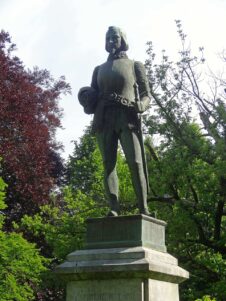 Everyone is probably familiar with the image of the glittering court of Elizabeth I, the ‘Virgin Queen’ surrounded by glamorous courtiers like Sir Walter Raleigh (founder of Virginia in America, who brought back the potato and tobacco to England) and Sir Francis Drake, whom the Spanish call ‘El Drake, the Pirate’.
One of the most dazzling of these courtiers was Sir Philip Sidney, nephew of Robert Dudley, Earl of Leicester, a close friend of Queen Elizabeth I. Both of them were leaders of the Elizabethan Renaissance in the 16th century. But the word ‘courtier’ does not do justice to Sir Philip Sidney. He was a brilliant poet, a diplomat who, already at the age of 20, was entrusted with important international missions, and a soldier. Beyond all this he seems to have been that rare thing – a good man. As he lay dying from a battle wound, he is said to have passed his water flask to the soldier lying next to him, saying, “thy need is greater than mine.”
Sidney was also the leader of the literary and scientific group known as ‘the Sidney Circle’, which dominated the court of Queen Elizabeth in its halcyon years. He is described as “erudite, open-minded and generous” – a true Renaissance man.
What many people are not aware of is how this circle, and others like it, were infused with what the scholar Frances Yates calls “The Occult Philosophy in the Elizabethan Age.”[1] There is an interesting web of connections to support her theory. For example, Dudley was a close friend and powerful protector of John Dee, the famous Elizabethan Magus. In turn, Dee was the mentor of Sir Philip Sidney, who had been his personal pupil. John Dee was so influential that when he published his esoteric work Monas Hieroglyphica, Queen Elizabeth asked him to come and explain it to her in person, showing that she had a real interest in these themes.
It was the Sidney Circle that welcomed the occult philosopher Giordano Bruno during his visit to England and devoured his works (he wrote more works in England than anywhere else). The philosophy and ethos of the Sidney Circle was Platonic, Neoplatonic, Hermetic and Cabalistic.
Bruno dedicated two of his Italian works written in London to Sir Philip Sidney: The Expulsion of the Triumphant Beast, a critique of Catholic and Protestant religion, which calls for a new world based on virtue; and The Heroic Frenzies, a series of allegorical love poems inspired by Neoplatonic ideas and his own concept of the ‘heroic philosopher’. You might wonder why works written in Italian would be so popular. The reason was that the Italian language became highly fashionable at Elizabeth’s court at this time (because of the Italian Renaissance), so all cultured people knew the language and could read Giordano’s works. Sidney himself had studied law in Padua and returned to England full of enthusiasm for Italian Renaissance ideas and poetry.
Bruno met Dudley and Sidney through the French Ambassador in London, at whose house he was staying. It was probably through Dudley (who was chancellor of Oxford University) that Bruno obtained a post there for three months as a lecturer. It was common for the great philosophers of those times to have powerful protectors, without whom they would have quickly fallen victim to the religious authorities, as happened to Bruno at the end, when he was tried for heresy and burned at the stake in 1600.
Another of the leading lights of the Sidney Circle was the poet Edmund Spenser, author of The Faerie Queene – an allegorical work celebrating Queen Elizabeth I and exploring the concept of virtue – and also of The Four Hymns: to Beauty, Love, Heavenly Beauty and Heavenly Love. He is universally recognized as having been a Neoplatonist, but also a Christian Cabalist. The Cabala describes the ascent and descent of the soul through multiple worlds. The Christian Cabala originated in Italy with Pico della Mirandola and its influence can even be found in the works of the 17th century English poet, John Milton.
Dame Frances Yates, the great scholar of the influence of the occult philosophy on history, writes that “the Spenserian movement expressed a Renaissance philosophy turned towards Puritan reform and infused with what has been called ‘Puritan Occultism’.”
Dudley was a leader of the Puritan party, and so was Sidney. We cannot think of either of them as ‘classic’ Puritans, since they were Elizabethan courtiers. Indeed, there is an interesting painting at Sidney’s house, Penshurst Place, where Dudley is shown dancing with a lady whom he is lifting high in the air in a very non-puritanical fashion! However, both men promoted moral purity in the sense of the cultivation of virtues. Hence Sidney’s patronage of Bruno’s book The Expulsion of the Triumphant Beast.
This ‘Puritan Occultism’ was part of the Reformation movement, which was a reaction against the corruption of the Catholic church. As part of this movement, and perhaps even guiding it, John Dee promoted the idea of a ‘British Empire’ which would lead Protestant Europe against the ‘Papal Antichrist’. It is interesting to see these ‘occultist’ origins of the British Empire, and how that empire developed into something very different in the 19th century. One example of this is that Sir Walter Raleigh, whom we may consider a disciple of John Dee, believed that England could build an empire without the conquest of native peoples, an empire in which English settlers and American Indians would live together, or, alternatively, where natives became allies and England would not interfere with their way of life.[2] How different from what happened later!
However, when Dudley led his troops to defeat in the Netherlands, he fell into disfavour with the queen, and other forces became dominant in England and Europe. After that the dream of a ‘puritan occultist’ Europe (and world) faded. Dudley was disgraced, Sidney died from a wound sustained in battle, and John Dee lived his last years in dire poverty and neglect at his home in Mortlake (Surrey). Edmund Spenser also died, according to one of his friends, “for want of bread”.
The powerful patrons had withdrawn their protection, and the ideal of a peaceful world governed by virtue seemed to vanish like smoke from a fire that no longer burned. According to Frances Yates, however, that fire was merely transferred to other movements[3], with different names, and continued to influence society for the better. If this is true – and Yates’s arguments are persuasive – then it gives us hope that the forces of good never give up and never disappear from the face of the earth. And that one day they will succeed in realizing the eternal dream which is so well expressed in some lyrics from Mozart’s opera The Magic Flute: “Come down, O Peace, return into men’s hearts. Then earth will be a paradise again, and mortals will be like gods.”
Image Credits: By Gouwenaar | Wikimedia Commons | CC0 1.0
Related posts:
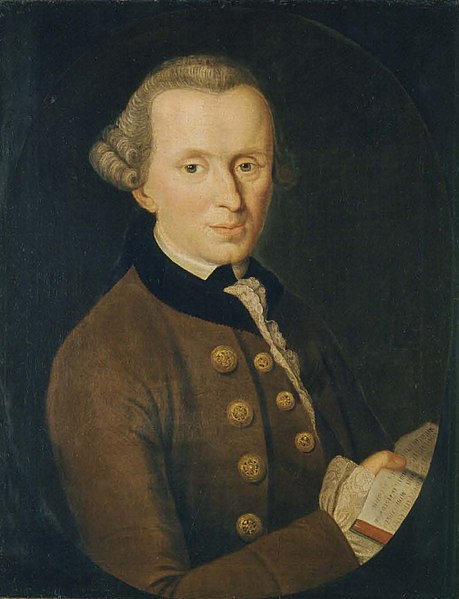
Image References
By Gouwenaar | Wikimedia Commons | CC0 1.0
Permissions required for the publishing of this article have been obtained
Article References
[1] Yates, F. The Occult Philosophy in the Elizabethan Age. Routledge Classics, London (2001). [2] See Walter Ralegh: architect of Empire, by Alan Gallay. Basic Books, New York (2019) [3] See her later book The Rosicrucian Englightenment. Routledge Classics, London (2001)
What do you think?