The Legacy of Kant
Article By Julian Scott
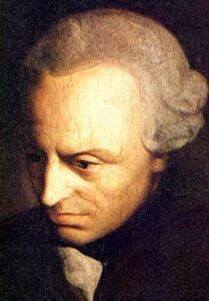 This article cannot possibly cover the entire legacy of the 18th century philosopher Immanuel Kant, as he had a profound effect on so many fields, but I will focus on one in particular: the legacy of doubt.
It all stems from what is known as Kant’s “Copernican Revolution” in philosophy. Copernicus proposed that the Earth revolves around the sun and around its own axis, thus transforming the former geocentric world view into a heliocentric one. In a similar way, but on an intellectual level, Kant explained that the order we think we see in the world is not the actual order, but is imposed by our own mental structures. In this way he transformed the former God-centred worldview into a human-centred one.
In the 17th century philosophy had alternated between rationalism and empiricism: those who held that the world can be understood by the use of reason alone (such as Descartes), and those who claimed that we know reality through experience, specifically the experience gained through our senses and through scientific experiment. The ‘Father of Empiricism’, Francis Bacon, proposed that we can know reality simply by observing what we perceive without any assumptions. Kant argued, however, that “no human experience is pure, neutral, without unconscious assumptions or a priori orderings”[1]. As Richard Tarnas writes in his excellent history of Western philosophy, Kant “criticized Locke [another empiricist] for believing that sense impressions alone, without a priori concepts of understanding, could lead to knowledge. And he criticized Leibnitz [a rationalist] for believing that reason alone can calculate the universe.”
One of the central ideas of empiricism is that the only knowledge we can be sure of is that which we receive through our senses. But it is clear that we need reason to verify this knowledge. For example, our eyes tell us that the Sun rises and sets every day, but our reason allows us to deduce that this is an optical illusion. In reality the Sun is not moving in relation to the Earth: it is the Earth that rotates around the Sun, as well as around its own axis. This reasoning can then be verified by experiment. So in practice, rationalism and empiricism work together.
But Kant goes further than this: he claims that neither rationalism nor empiricism can know reality. Our reason can take logical steps within certain limits, but it cannot know the ultimate origin of things, nor their ultimate purpose. These are metaphysical factors which reason cannot know. Therefore, metaphysics is impossible, Kant said, because in metaphysics every argument has its counter-argument, every thesis its antithesis.
Empirical science cannot help us either in our search for reality, because science can only know ‘phenomena’, a word of ancient Greek origin which means ‘appearances’. Science cannot know, for example, what a horse is in its essence, in its real being (if such exists); it can only analyze and describe its parts, functions, physical features, etc. To quote Tarnas again, “He [Kant] now recognized that man could know only the phenomenal and that any metaphysical conclusions about the nature of the universe that went beyond his experience were unfounded. Metaphysics therefore went beyond the powers of human reason.”
Where, then, does this leave us? And where did it leave Kant?
Kant accepts that there are some things that can be known about the world: ‘phenomena’ – as opposed to ‘noumena’, the real beings whose existence we cannot know. The phenomenal is the limited realm of science.
But even this knowledge is not certain, because we perceive things through certain structures in our mind. In the first place we perceive everything in time and space. But time and space are not, for Kant, things in themselves; they are what he calls “a priori forms of human sensibility.” Things may not actually be in time and space, but this is how we perceive them: if we think of some event in our life, it is always related to some place; and every event is also associated with a time.
Then there are the ‘a priori categories’ of the mind, of which there are 12 according to Kant, following the Aristotelian system. By way of example let us take the category of ‘causality’. We believe that everything has a cause, but there is no actual evidence for this (as Hume pointed out), only probabilities and assumptions that this is the case. But this category of causality enables us to impose order on the world, which may or may not be ordered in itself (Kant suspends judgement on this point). As Tarnas explains: “The mind never experiences ‘what is out there’ in some clear undistorted mirroring of objective reality. Reality is of man’s own making … one can never know the world… Man perceives an order in the world grounded in his own mind.”
These last words bring us with a bump into the world of the present. Most of us have been brought up in this way of thinking and live with it for the rest of our lives – whether subconsciously, unconsciously, or occasionally consciously. It particularly applies to spiritual and metaphysical beliefs. We are told that belief in God, the soul, an afterlife, an ordered universe, are ways of coping with and not facing the absurdity of existence. We are imposing an order on life which is not there and is just the creation of our mind. And the same goes for all forms of knowledge: we impose an intellectual order on the chaos of events and call it ‘history’, or even worse, ‘destiny’. We make countries from artificial orderings of geography. You can perhaps see where this is going: in the end, the human mind becomes a prey to doubt and begins to feel a philosophical angst resulting from the sense that life is meaningless in a meaningless universe.
But let us pause for a moment and return to a more natural and less man-centred way of thinking. We think we are the only rational beings, the most evolved beings. But in antiquity people believed in ‘gods’, i.e. in higher, superhuman intelligences, more advanced than us in the great chain of being. And not only did they believe, some people actually conversed with them and knew them.
Plato, for one, said that we are like prisoners in a cave, discussing opinions in the dark. But outside the cave is a world of spiritual reality, which can be accessed, known and experienced by all human beings if they follow the necessary steps to achieve it. And this knowledge is real, not imagined.
Returning to Kant, Tarnas says: “The problem with his epistemology is that man cannot know if his understanding corresponds to a universal reality, or if it is just a human reality. This is called ‘Kantian subjectivism’.” And he continues: “Kant’s penetrating critique had effectively pulled the rug out from under the human mind’s pretensions to certain knowledge of things in themselves, eliminating in principle any human cognition of the ground of the world.”
And returning to the ‘Copernican Revolutions’ – of Copernicus and Kant – he adds that “Both Revolutions awakened man to a more adventurous reality, yet both also radically displaced man – one from the centre of the cosmos, the other from genuine cognition of that cosmos. Cosmological alienation was therefore compounded by epistemological alienation.”
How did Kant resolve this sense of alienation within himself?
After his damning critique which resulted in the conclusion that metaphysics is impossible, he added as a kind of postscript that there may be other ways leading to the ‘objects of metaphysics’ apart from the way of rational knowledge. He finds these ways in the ‘moral conscience’ of the human being and he calls this the way of the ‘practical reason’ (as opposed to the ‘pure reason’). This led him to the concept of the Good Will, which acts out of duty and not by inclination. Morality for Kant is not to do good out of fear of punishment or desire for reward, but to do so for the sole reason that we believe it to be good. From this moral philosophy came Kant’s famous axioms: “Act only on that maxim through which you can at the same time will that it should become a universal law” and “Act so that you treat humanity, whether in your own person or in the person of any other, never merely as a means but always at the same time as an end.”
This is the other side of the coin of Kant’s legacy, a legacy that gave rise to the legal concept of the inviolability of the person and the unconditional worth (dignity) of every rational being – the moral foundation of human rights.
Kant’s love of true morality and his deep respect for the cosmos were perhaps what gave rise to one of Kant’s most famous sayings: “Two things fill the mind with ever new and increasing admiration and awe, the oftener and more steadily we reflect on them: the starry heavens above and the moral law within.”
So, was the poet Heinrich Heine right when he compared “the little professor of Könisberg with the terrible Robespierre [architect of the French Revolution’s Reign of Terror]; the latter had merely killed a king, and a few thousand Frenchmen… but Kant, said Heine, had killed God, had undermined the most precious arguments of theology.”[2]
Or should we agree with Roger Scruton, who called Kant “the greatest modern philosopher”[3]?
Perhaps both are right in their own way, and we can see in Kant a great philosopher who helped form the world we live in today, with both its positive and negative aspects.
Image Credits: By /History/Carnegie/kant/portrait.html | Wikimedia Commons | CC BY PD
Related posts:



Image References
By /History/Carnegie/kant/portrait.html | Wikimedia Commons | CC BY PD
Permissions required for the publishing of this article have been obtained
Article References
[1] Tarnas, R. The Passion of the Western Mind (Pimlico, 1996) [2] Durant, W., The Story of Philosophy (Pocket Books, 2012). [3] Scruton, R., Kant (Oxford Paperbacks, 1988)
What do you think?