The Mysterious Art of Being Victorious
Article By Jorge Angel Livraga
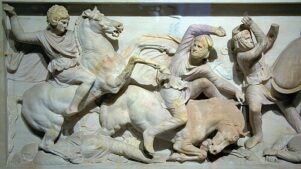
Macedonian army with Alexander. Istanbul Archeology Museum.
To be a philosopher is to stand upright like a spear, advancing against the wind through the mist, beyond the known and the unknown. A philosopher is someone who is in love with Truth, in love with Wisdom, one who places all things below the search for that Wisdom. A lover is not perhaps an entirely intelligent person, but is someone who is convinced that they are going to reach the goal they has set themselves; someone noble who tries with all their strength to attain that which can be glimpsed beyond appearances.
Macedonian army with Alexander. Istanbul Museum.
The topic I am going to address today is the mysterious or difficult Art of Being Victorious. When I say ‘being victorious’, I am not referring to defeating anyone, breaking down doors, tearing down walls or feeling that others are weaker than ourselves, but to something much deeper. Many years ago, I had a Teacher who used to tell me that the Art of Happiness lies in achieving goals, but not at the expense of others, not based on the unhappiness of others; and in a way, the Art of Being Victorious consists in being able to reach our goals without using others as stepping stones, without clambering over the heads of the weak, without trampling on those who appear to be standing in our way, but achieving them in a very different way – wholeheartedly and with all our strength. What is this difficult or mysterious Art of Being Victorious?
There are people who, it seems, are born under a lucky star and everything goes their way. There are others, on the other hand, for whom every achievement is very difficult. And sometimes we come across the Chosen Ones of History, who, by their mere presence, can achieve real miracles.
And how often, my dear friends, do we find ourselves in life wanting to achieve some feat, to do something exceptional, wanting to move forward in such a way that everyone will see us and follow us, and yet we can only take small steps? How often have we wanted to sing like blackbirds, how often we have wanted to fly? And yet all that come out of our throats are weak, incoherent sounds, or we can do no more than walk on our own feet, walking and walking towards a never-ending horizon. So this is why, we ask ourselves, with all our hearts, as philosophers, what the Art of Being Victorious entails. Why are some victorious while others are not?
Perhaps, my dear friends, life is like this microphone cable I am holding in my hands: we don’t know exactly how long it is, so we must be ready and sensitive enough to notice when we are getting near the end of it, when adversity is somehow warning us that this is as far as we can go.
The act of being victorious, then, would not mean that we should all become Alexander the Great, because not all of us can be Alexander, nor can Alexander be each one of us. Each of us is what he or she is, and the Art lies in being what we truly are, at our real level, at our own level, however big or small we are.
Today, we imagine everything through formulas; all victories and solutions are thought of in terms of systems. If something goes wrong, the political system is at fault; if we have financial problems, the government is at fault; and we never stop to ask ourselves: might it not be something human? In some way, might it not be me who is at fault? Up to what point are systems valid? To what extent does the true value not lie in this tiny piece of God which is in love, which is Man?
Human beings have their fundamental value; that is why the ancients did not seek to teach human beings extraordinary truths, extremely mysterious things, but rather sought to purify them, to cleanse them of all worldly things, to free them from their own animality, their fears, from everything that might hinder their progress, so that they might emerge from within outwards, like the white lotus, from the very heart of things; and ascend to that epopteia of attaining the completion of each thing, which is represented in the columns of temples when we see their capitals opening up many metres above the ground. No column opens its capital at the base; they all do so at the top. The ancients have left us a legacy of teachings on all of this recorded in their images.
In ancient civilisations people were generally trained through four major groups of Trials: Earth, Water, Air and Fire. Exoterically – in other words, externally − this does indeed really have to do with earth, water, air and fire, but esoterically it relates to certain components of our personality: namely, our physical body, our vehicle of energies, our psychological vehicle and our mental vehicle – that vehicle from which all the things that we receive, obtain and offer arise. But the Trials themselves were indeed of a truly physical nature and were real − very real indeed.
One of the great mistakes we make is that, if we stand at the bottom of a staircase, we look at the whole thing and wonder whether to climb it or not. That is not the right psychological approach to facing adversity; rather, we should set out to climb one step at a time. What is my immediate problem? This step, not that one, nor the one after that! If we set our sights too high − something that often happens to many idealists and spiritually-minded people − it is easy to stumble on the first few steps and fall down into the abyss. We must know where we want to go, but step by step, slowly, and without overplanning. If we know how to stretch out our hand, there will always be some kind-hearted angel, real or imagined, who will take our hand and help us on the path.
You know that the best swords are made by being hammered, and they are passed from heat to cold, from cold to heat, in a really brutal manner. Don’t we also need to be tempered, to receive the blows of life, just as the sword receives the blows of the hammer on the anvil? Anyone who has ever watched a blacksmith at work will know that the hammer blows are accompanied by other sounds. These are the cries of the metal as it feels itself being flattened. Yes, the sword cries out but it endures; it cries out and endures, cries out and endures; until at last that iron – which was nothing more than a simple and basic metal, becomes transformed by the blows – and by having been immersed in the cold waters or in the mysterious substances of the alloy – into a bare blade of steel. And then it acquires hardness, sharpness and suppleness. Is this not somehow similar to the process of our own forging in life?
We must regain that inner quality of being tempered, understand that if we fall, it is simply in order to get up again. No one falls forever, for everything in this world is transient. Everything has a relative value: both our successes and our failures. On the basis of that humility of heart, we can really keep moving forward. If we manage to master those four elements of Nature within ourselves – the elements of Earth, Water, Air and Fire – we may not be able to perform miracles – we are not children of Amon after all, at least not directly – but we can achieve some remarkable things.
There are some simple exercises that can help us understand this. Take any bottle filled with water, stretch out your arm and hold the bottle upright. At first it seems very easy – after all, who can’t hold up a bottle of water? But as time passes and the accumulation of the weight and the position of our arm become increasingly painful, we feel the weight more and more, and it feels as if a cow were hanging from our arm.
Try something different; activate your Will. Get your eyes and your mind to start counting, for example, the different light bulbs on the ceiling (without letting go of the bottle). You’ll find that it’s much easier to endure if you keep your mind focused away from the pain.
The same applies to life. If you allow your mind to cling on to every single problem, to that little death that we suffer every day, to the fear we haven’t been able to wash away because we are not living in the 5th century BC, you will not be able to withstand even the slightest blow of adversity.
So we have to try to raise that hand, to free it a little from the things of the world, to assert our Will little by little – a Will that should not be ostentatious, but should walk alone, in a natural way.
When you face any serious adversity, always try to hold out for one minute longer; don’t think that you are going have to endure for an hour, a day, a year, or a whole lifetime; no, no, just a minute longer, no more than a minute, then another minute, and so, little by little, all those minutes will add up to something greater. The power of our mind is tremendous. Try another experiment: measure the psychological duration of a minute. When the second hand reaches its zenith once more, when it has travelled all the way around the clockface, you will receive a great reward, an immense happiness (let each of us dream of whatever happiness we wish). You will see how slowly the second hand moves; it almost seems as if it were moving backwards. Now let’s try the experiment the other way round: imagine that when the second hand goes full circle again, a bomb will go off underneath us; then you will see how quickly time races onwards, tick after tick – one might say the clock has gone mad. Yet the clock always marks the same instants with exactly the same rhythm.
What has changed? Our perspective. If we desire something with too much passion, it will seem infinitely distant to us.
We must learn to give life the value it truly has; then we will gain a much truer sense of everything that happens to us. Nowadays we generally run after money, fame, recognition, a better car, a bigger flat, the latest fridge, which makes round ice cubes… As a result, we’re always in a state of tension; nothing is ever enough for us, because we always feel that we have too little, that we need something new. That is the great spectre of consumerism that has become ingrained in our souls, and it is one of the worst forms of materialism.
Let us learn to be content with simple things. I’m not saying we should give up on having more; I’m simply saying we should be at peace with our own hearts, and then see how we can become a little more prosperous. The secret lies in truly knowing what we can do, how we can do it and putting all our attention and all our strength into it.
In truth, we have more strength than we think. Each one of us, however small we may be, has great possibilities. Some people might think: ‘I’m not going to write any poems, because who’s going to publish them anyway? I’m not that good.’ Let us lose a little of that sense of comparison, of competition, that kind of unhealthy contest we’ve been dragged into. Let us get out of that mindset and do things for their own sake. If poems come to your soul, if they descend upon you like birds alighting in their nests, welcome them, keep them, set them free – it doesn’t matter if no one publishes them!
When there were no printing presses, how did poets manage? In Sappho’s time, how did that sublime poetess manage to share her creations with the whole world, so that they survived until the Middle Ages, when they were unfortunately destroyed? There were no printing presses, no publishers; she simply had her poems, and those poems were passed from hand to hand, little by little. We don’t need great resources for our creations and discoveries to be real. I began writing the book I love most when I was nineteen, and I never thought it would be published; I just wrote it because I felt like it.
How many of us have books inside us, messages, treasures, characters? We must bring them out; we must find the strength to draw them out of ourselves and show them to the world, which is thirsting for spontaneous things. The world is tired of being spoken to through the great frameworks of systems and wants to be spoken to from the heart, from man to man, woman to woman, person to person. Hence the ancient Roman concept of concordia, heart to heart. That is not equality – no, equality is sterile – but rather something that enables one thing to complement another, like the teeth of a gearwheel, where the teeth of one slots into the gaps left by another… And in that interlocking of the teeth of one wheel into the gaps left by another, lies the possibility of transmitting force: spiritual force, physical force – what does it matter! Inner force… the inner strength that is carried in the arms of Victory, that final Victory which awaits us all, through small, everyday achievements – those everyday achievements that must be sustained and must fill our hearts with faith and hope.
Perhaps you paint pictures, perhaps you draw; go on, do it! It doesn’t matter whether people recognise them or not. Beyond people, beyond our surroundings, there is another Judge, a Judge so great that we cannot say how great He is. So good that we cannot imagine Him and so very just that, beyond our actions, He reads the hearts that inspired those actions.
And that great Judge will somehow spread his cloak over us and protect our small achievements, our little hopes: the verses we have never written, the drawings we have never made, the loves we have never known, the opportunities that slipped through our fingers, but which live on in some magical way in that world of sublime redemption, and which will accompany us, through the millennia, towards an inner and total self-realisation.
Each and every one of us – even the smallest, even those who feel most inadequate, even those who believe they are most alone – has the capacity for Victory. We have the ability to press on and on through those small successes, those small steps that will gradually propel us forward.
There is no need for formulas or special support; one can always move forward, perfecting oneself more and more. Each of us must seek our own Light, our own place, and if we are happy where we are, so much the better! And if we are not happy, we can find happiness elsewhere. The most important thing is not to harm anyone; the most important thing is to burn the wax of our own candle, not our neighbour’s. The most important thing is to have Light. We have to choose: let us suppose we have a candle; do you want to have that candle, or do you want to have Light? If you want to have a candle, you’ll spend your whole life in the dark; if you want to have Light, you’ll have to burn that candle, take a match, strike it and light the candle, and let the Light burn – that Light which is always vertical like a luminous sword.
One way or another, material things fall, break and disappear. The ancients used to say: ‘omnia transit’; everything passes, everything moves on… everything flows towards the sea, just as the waters flow; everything has a Destiny – let us align ourselves with Destiny! Let us see how the waters flow down the mountains, singing; and which are the purest waters? Those that crash hardest against the rocks, those that cascade down in waterfalls and explode into great bursts of white foam; the others – the cowardly waters, those that remain still in backwaters – eventually become stagnant, and no living creature can live in them.
Where are those magnificent human beings of former times? Where are they, if not within us? They have not been forgotten, they have not been lost; we have simply buried them under rubbish, fear and uncertainty.
Let us cast all that aside, and we shall once again see the feathered helmets; we shall once again see the light of the sky through the broken walls; and we shall once again feel our footsteps marching in time with the beating of our hearts within our chests. Victory, Victory, Victory!
Image Credits: By Ronald Slake | Wikimedia Commons | CC BY-SA 3.0
Related posts:


Permissions required for the publishing of this article have been obtained
Article References
Lecture delivered in Madrid, October 1990.
What do you think?