The Most Important Job in the World
Article By Sabine Leitner
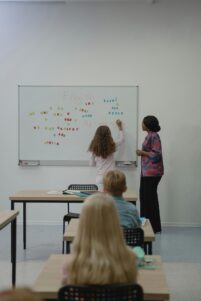 Bringing up children has never been an easy task, and maybe it is even more difficult today. Previous generations had at least the benefit of a common set of values and a general consensus as to how to bring up children. But most parents are nowadays bombarded with conflicting advice from experts, books, blogs and forums, torn between liberal and authoritarian theories and afraid of ‘imposing’ views on their offspring. It is understandable that many resort to a passive attitude and try to interfere as little as possible in the ‘natural’ growing up of their children.
Others expect schools to step in and do the parenting for them; but it is not uncommon in conflicts between teachers and students that the parents take the side of their children and adopt the ‘good cop’ stance against the ‘bad cop’ teacher, thus undermining the work of schools. Maybe not surprising then that there are currently severe teacher shortages in England in most secondary subjects (BBC, August 2024) and that teachers report struggling with student behaviour and increasing demands from parents.
Social media also contribute to a feeling of pressure on parents to be ‘perfect’. They constantly flood us with curated images of idealized portrayals of family life, whilst never showing the struggles behind the scenes. And since we are nowadays more aware of child development and have a greater understanding of how early experiences shape children, we are constantly afraid of causing lasting traumas.
Further challenges are posed by modern technology, stressful and demanding jobs, rapid social change around issues like gender identity, inclusivity and evolving societal norms and the fact that most parents today have much less support from traditional community and family structures.
Since we can also still see and remember the negative effects of a ‘Victorian’ authoritarian upbringing, we all want to avoid making the same mistakes. However, going to the other extreme of parenting is not the solution. Because a lack of boundaries, discipline and guidance are proven to have equally negative effects on young people.
Examples of these negative effects of an excessively permissive and laissez-faire style of parenting are: low impulse control, poor emotional regulation, unrealistic expectations and a sense of entitlement amongst young people because they have learnt to get what they want without having to make an effort; a rise in narcissism, interpersonal problems, poor work ethic, disrespect for authority, difficulty handling disappointments, etc.
I am not saying that all young people nowadays display these tendencies. My point is that every parenting style has a certain impact and that there is no point replacing the negative effects of a Victorian upbringing with the negative effects of an overly permissive upbringing. More than anything else, we need well-rounded human beings who are able to face and solve the problems we have created and who can continue to make this world a better place for all.
We have made so much progress in so many fields. But have we also made equal progress in the art of bringing up children? It might be impossible to answer this question, but as a teacher with more than 30 years’ experience of working with teenagers, I am sometimes worried about our young people and whether they are well prepared for the demands and responsibilities of adulthood and the challenges that lie ahead.
Regarding the range of parenting styles: I feel that we need to work towards balance and a ‘union of opposites’: we do need to enforce boundaries but also allow freedom; teach respect and yet allow the questioning of authority and rules. We all have our default modes and either err on the lenient or the strict side. But it is important that we learn how to manage polarities. This requires reflecting on the value of the opposite pole and developing skills from the opposite style. ‘Reacting’ to the ‘shadow manifestation’ of a pole by avoiding it altogether will not help.
I agree with John F. Kennedy’s statement that “children are the world’s most valuable resource and its best hope for the future”. But in view of the sharp rise of mental health issues, behavioural issues, physical health problems and lower life satisfaction in our young people, we have to admit to ourselves – as a society and as adults – that we haven’t quite achieved the right balance in bringing up our children yet.
Image Credits: BY Tima Miroshnichenko | Pexels | CC BY PD
Related posts:

Image References
BY Tima Miroshnichenko | Pixels | CC BY PD
Permissions required for the publishing of this article have been obtained
What do you think?