What the myths of Proteus and Janus tell us about Change and Transformation
Article By Sofia Venuti
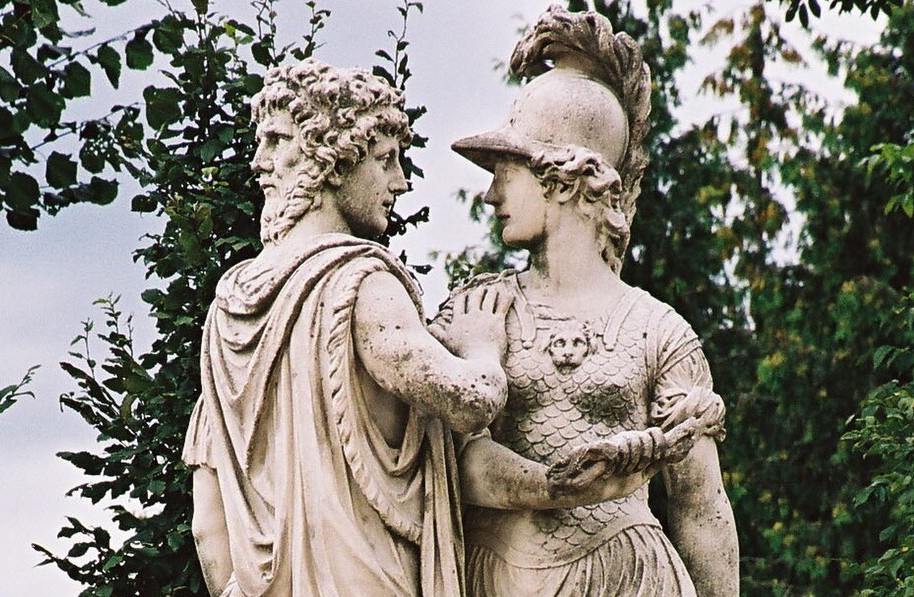
Statue – Janus and Bellona
Our current sociopolitical climate can cause a fear of change and a want of permanence – of identity and ideology for example. The philosopher looks back and sees that the ancient world offers a sobering counterpoint: a reverence for change, mutability and the transient. This is vividly portrayed in the myths of Proteus, the elusive sea god of Greek lore, and Janus, the Roman deity of beginnings and transitions. Though they arise from distinct cultural contexts, both deities embody fundamental philosophical questions about change: its nature, its necessity and its relationship to knowledge and time. Through these mythic figures, we are invited not only to contemplate the inevitability of change, but to consider how we might live wisely in its midst.
In Greek mythology, Proteus is a minor sea god, sometimes described as a servant of Poseidon, whose most famous attribute is his ability to change shape at will. According to Homer and later Virgil, Proteus possesses a secret knowledge of all things – past, present, and future – but will only reveal this truth to those who can hold him fast through his metamorphic transformations. He becomes fire, water, a beast, a tree, all in an attempt to evade the inquirer. Only once he is held firm does he relent and speak truth.
This motif of truth concealed behind transformation offers a rich philosophical metaphor. Proteus suggests that truth is not static, and that access to it requires endurance through change. The seeker of wisdom, like Menelaus in the Odyssey, or the alchemist, to bring in another image, must resist the temptation to retreat when confronted with the strange or disorienting. The Protean trial becomes a test of philosophical temperament: are we willing to hold fast through confusion, contradiction and flux? The seeker of wisdom must also resist the temptation to rest on their laurels once they ‘think they know’ – are we willing to never cease seeking truth?
From a metaphysical standpoint, Proteus symbolizes a pre-Socratic worldview, where being is not fixed, and the world is a constant becoming. Heraclitus, whose doctrine of perpetual flux (“you cannot step into the same river twice”) aligns with this Protean imagery. Here, change is not a deviation from reality, but its very essence. To know the world is not to arrest it in fixed categories but to move with its transformations.
Yet there’s a paradox: although Proteus is constantly changing, he is also always Proteus. Beneath the mutable forms lies a continuity – a persistence of identity. This tension between appearance and essence, flux and persistence, reflects enduring philosophical debates, from Plato’s realm of unchanging Forms to modern existentialist concerns about authenticity in the face of social roles. Is there a ‘true self’ beneath the roles we play, or are we, like Proteus, constituted by the very transformations we undergo?
If Proteus embodies the metaphysics of change, then Janus, the Roman god of gates and animistic spirit of doorways, embodies beginnings and transitions and represents the temporal and ethical dimensions of these. Most famously depicted with two faces, one looking to the past and the other to the future, Janus presides over moments of passage – from one state to another, from old to new. The month of January, a time of resolutions and retrospection, bears his name.
Unlike Proteus, who resists disclosure and thrives in ambiguity, Janus welcomes awareness. He stands at the threshold, a conscious guardian of transitions. For the Romans, Janus was not just a symbolic figure; he was ritually invoked at the outset of every endeavour, from military campaigns to agricultural seasons. His dual gaze represents a philosophical stance: that to move forward wisely, we must look backward honestly.
This temporal duality has ethical implications. Change, for Janus, is not chaotic but structured and consequential. Every new beginning carries the memory – and sometimes the burden – of what came before. In this way, Janus reminds us that change is not erasure, but transformation. One cannot pass into a new identity, role or epoch without reckoning with the past.
Philosophically, Janus invites us into a phenomenology of transition. What is the experience of being ‘in-between’ – not quite what we were, not yet what we will become? The liminal moment is often one of discomfort, uncertainty or even crisis. Yet it is also a site of potential, creativity and redefinition. Janus encourages us to embrace the anxiety of becoming as the price – and privilege – of freedom.
When we juxtapose Proteus and Janus, two distinct but complementary visions of change emerge. Proteus is the ontological trickster, representing the flux of nature and the elusive nature of truth. His transformations challenge the mind, demanding philosophical resilience. Janus, in contrast, is the temporal mediator, guiding us through personal, social and historical transitions with a sense of continuity and responsibility.
Together, they frame change as both mystery and process. Proteus teaches us that change is inevitable and that seeking truth demands we face it head-on. Janus teaches us that change can be meaningful – that it matters how we navigate it, how we honour the past while moving toward the future.
This dual perspective is particularly relevant in our contemporary world, where rapid technological, social and environmental transformations often leave us feeling either disoriented (like those who chase Proteus but can’t hold on) or paralyzed at the threshold (like those who face Janus but can’t choose a direction). In such a world, these ancient myths remain potent tools – not as literal beliefs, but as philosophical models.
So, what guidance do Proteus and Janus offer to the modern thinker?
From Proteus, we learn that intellectual and personal flexibility is essential. In a world of shifting narratives, fluid identities and rapid change, the ability to stay engaged through transformation (without clinging to illusion or retreating into rigidity) is a philosophical virtue. We must become, in some sense, Protean ourselves.
From Janus, we are reminded that change is not merely something that happens to us, but something we participate in. We must become stewards of our transitions, attentive to both memory and intention. Janus’s gaze prompts us to integrate reflection with foresight, recognizing that change, while inevitable, is also ethical: how we change matters.
Proteus and Janus – shape-shifter and gatekeeper – are not just relics of mythology but enduring archetypes of the human condition. In their myths, we find a philosophy of change that is neither nihilistic nor naive. They remind us that while we may not control the tides of transformation, we can choose how to navigate them – with courage, with consciousness and, above all, with the willingness to face both the past and the future at once.
In a time when change feels both exhilarating and exhausting, perhaps these ancient gods can guide us – not with answers, but with better questions: Who am I becoming? What must I hold fast to? And how can I pass through the next threshold with integrity?
As the world turns – and it always does – Proteus shifts again, and Janus stands watch. Will we understand what they’re telling us? How will we choose to act?
Related posts:
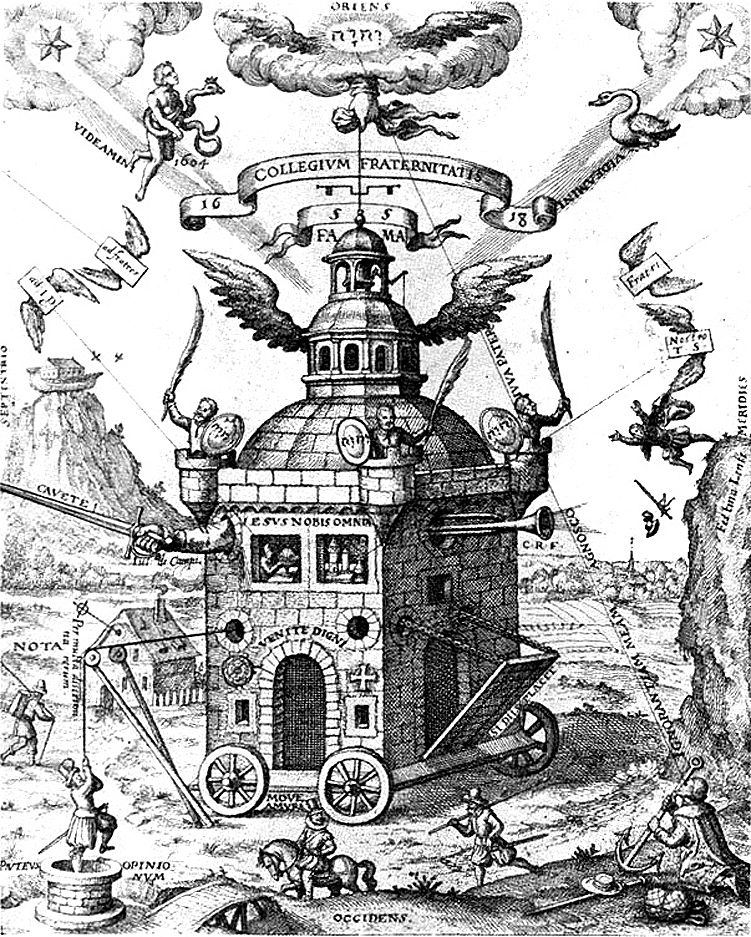
Image References
By WikimediaCommons | CC BY PD
Permissions required for the publishing of this article have been obtained
What do you think?