When You look at this painting, what do YOU see?
Article By Dave Cole
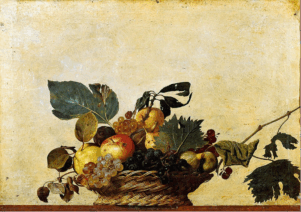
Is it just a depiction of a basket of rotting fruit? Or a philosophical discussion on the fragility of life?
This painting is by one of the greatest artists of the Renaissance in Italy – Michelangelo Merisi da Caravaggio, who depicted images of great realism with emphasis on tonal colour palette, using dark and light. The varied use of light and dark in his paintings captured the quality of a world with no electricity, so candlelight or angled daylight are his way of depicting how dependent we humans are on seeing our world with light.
Caravaggio was active in Rome for most of his artistic life. During the final four years of his life, he moved between Naples, Malta and Sicily. He died in 1610 at just 38 years of age. Arrogant, rebellious, a gambler, fighter and fornicator, Knight of Malta and murderer, Caravaggio’s short and tempestuous life matched the drama of his works. Characterized by their dramatic, almost theatrical lighting, Caravaggio’s paintings were controversial, popular and hugely influential on succeeding generations of painters all over Europe.
To describe his character, a friend of mine said “Good painter, dodgy character” – in a Scottish accent – which is how the art world has generally seen such a troubled but glorious artist. But for me he is a real challenging and purposeful artist to be admired and emulated.
For Caravaggio, the simplicity of this painting of a basket of fruit and foliage on the verge of decaying offers a profound and deeply questioning view of life as we experience it in our everyday challenges. How are we to see ourselves any different from the fruit or leaves being depicted here? Are we not as fragile in ourselves and just as vulnerable to the bumps and falls in life as they are? And as you consider how life is evolving today, in such turbulence and vulnerability, you question not only yourself and your beliefs, but also the why, and what of any and every decision you have to make, as well as the decision-making of world leaders.
With crises and death on our doorstep, as we experience the natural disasters and man’s continued acts of violence against man and nature, this piece of art requires us to continually question our place in the world around us, and our part in its effect on all other life forms and the environment. It challenges us to dwell on deeper thoughts and philosophies as we seek to understand our individual acts and methods of living a good and decent life.
How do you reflect on the philosophies of Plato, Aristotle or any of the great Stoic philosophers when you are visually challenged by such real decay and vulnerability? You have to accept that you are as fragile and vulnerable in your own life.
This illustrates the saying that one bruised fruit will escalate to the whole basket, ending up decaying and rotting them all. It is clearly this that is being depicted here. Just as our life is not independent of all the other life forms on this fragile planet, so too do we need to be cognizant of the existence of the right of all forms of life to flourish.
This is how a great artist can communicate such a meaningful and profound question to each and every viewer of this simple painting. You need to look and really see the true meaning of what the artist is conveying, through pigment on the surface of the painting, to you the viewer, and reflect on your own vulnerability.
Caravaggio is reminding the viewer that they too have a very short time to digest and emulate the great philosophers of the East and West, on how to find a profound and meaningful way to live their lives and to flourish to the fullest, with the knowledge of their fragility and vulnerability in life. For we, just like the fruit, will eventually suffer the bumps and knocks of life, and wither and perish.
So let the painting be a guide to you that your span of fragility and vulnerability will end too. May I hope you flourish and live with a smile and enjoy it to the fullest.
Image Credits: By WikimediaCommons | CC BY PD
Related posts:
Image References
By WikimediaCommons | CC BY PD
Permissions required for the publishing of this article have been obtained
What do you think?