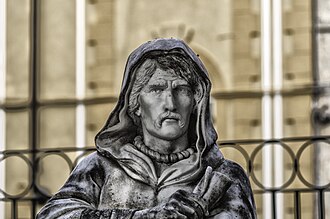
Giordano Bruno: A Mystic of the Infinite Cosmos
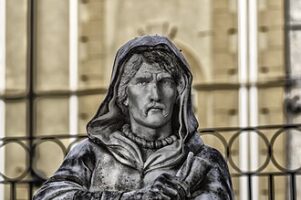 Giordano Bruno (1548–1600) was an Italian philosopher, mathematician and mystic whose radical ideas about the universe, God and human potential placed him at odds with the intellectual and religious authorities of his time – the Reformation and Counter-Reformation. A Dominican friar turned itinerant scholar, Bruno is remembered today as a visionary who challenged the dogmas of both science and theology, envisioning a cosmos far more expansive and mysterious than his contemporaries dared to imagine. His execution by the Roman Inquisition underscores both the boldness of his ideas and the threat they posed to the orthodox worldview of the late Renaissance.
Born in Nola, near Naples, in 1548, Filippo Bruno entered a monastery in the Dominican Order (where the theologian Thomas Aquinas had taught) at the age of 15, taking the name Giordano. He was drawn to philosophy and theology, and studied the works of Plato and Hermes Trismegistus, but his curiosity soon brought him into conflict with monastic authority. His questioning of established doctrines – particularly the veneration of saints and the Virgin Mary – drew suspicion. By the age of 28, Bruno had fled the monastery and began a life of exile, wandering across Europe from Geneva to Paris, London, Wittenberg and Prague, often living with people who gave him protection and often earning a living as a lecturer and tutor.
Bruno absorbed and synthesized a wide array of philosophical and esoteric traditions: Neoplatonism, Hermeticism, Lullism and the emerging Copernican heliocentrism. Unlike many contemporaries, he did not view science and mysticism as contradictory but as two dimensions of the same cosmic truth.
At the heart of Bruno’s philosophy was an intense mysticism rooted in the belief that the universe itself was a manifestation of the divine. Influenced by Hermetic texts – especially the Corpus Hermeticum – Bruno envisioned God not as a remote, personal deity, but as an immanent presence pervading all things. For Bruno, the divine was infinite, and so too must be the universe. To propose a finite cosmos, he believed, was to limit the divine itself.
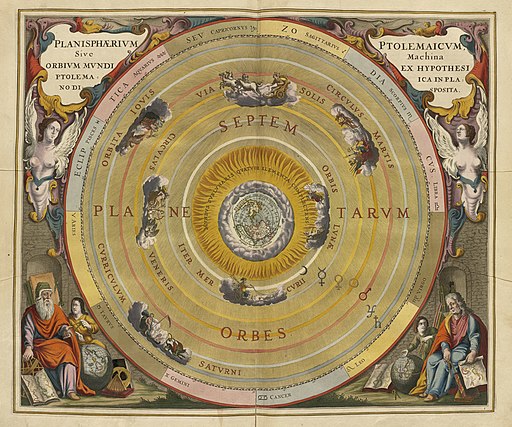
This pantheistic view led him to a vision of Nature that was both sacred and dynamic. He proposed that the cosmos was not a static, hierarchical structure with Earth at the centre, as Aristotle and Ptolemy had maintained, but an infinite expanse filled with countless worlds like our own. Bruno famously asserted: “There are innumerable suns, and an infinite number of earths revolve around these suns” (Bruno, De l’infinito universo et mondi).
Bruno’s mysticism extended to his view of the human soul. He saw the soul as eternal and capable of uniting with the universal spirit through contemplation, love and intellectual ascent. The soul longs to be free from the body and is lifted by love to ascend to the world of spirit. This theme was most powerfully expressed in his Heroic Frenzies – poetic dialogues on love, madness and the longing for divine union (Gli eroici furori).
Some of Giordano Bruno’s most influential ideas were:
- The Infinite Universe and Multiplicity of Worlds
Bruno took the Copernican model and extended it beyond its original conception. Where Copernicus replaced the geocentric system with a heliocentric one, Bruno exploded the very notion of cosmic finitude. He argued for an infinite universe, with no centre and no edge, filled with innumerable stars and planetary systems. This concept directly challenged the Aristotelian and Christian cosmology that placed Earth and humanity at the centre of creation. - Unity of Matter and Spirit, and Reunion through Love
Bruno rejected the dualism of body and soul. For him, spirit and matter were not separate substances but different expressions of the same divine essence. All matter was animated – a view that lent a mystical dimension to natural philosophy. He regarded Nature as a reflection of the Divine Mind: God (or the spirit of the Universe) made tangible. When we fall in love with Nature and take a path of ascension by understanding its depth and true reflection, we fall in love with God. - Memory and the Art of Knowing
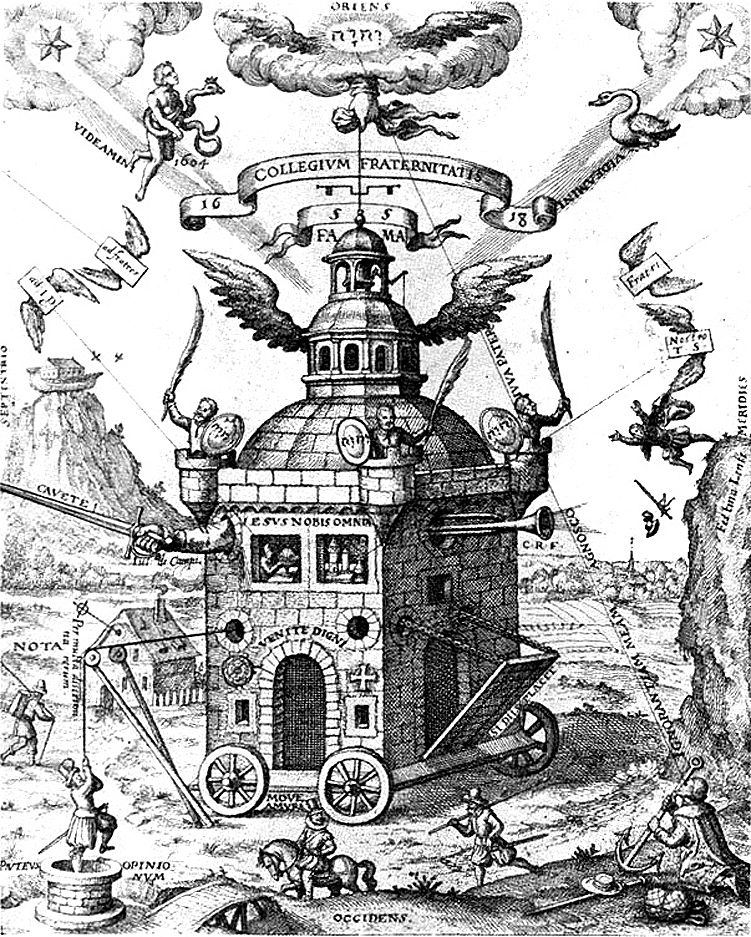
A master of mnemonic techniques, Bruno was deeply engaged with the art of memory, drawing on the work of Ramon Llull and classical rhetoric. He believed that memory systems could be used not only to retain information but to ascend towards divine truths. His mnemonic wheels and symbolic diagrams were both cognitive tools and metaphysical maps.
- Religious and Philosophical Freedom
Bruno championed intellectual freedom and was critical of religious dogmatism. He believed that truth could not be confined to any one doctrine or faith and called for a universal religion rooted in reason and nature – a vision far ahead of its time and, of course, a heretical one in the eyes of the Church.
In 1951, Bruno was invited back to Italy by a Venetian nobleman interested in his memory system, but was betrayed and arrested by the Inquisition for heresy in 1952. He spent some time in the Venetian prison “i Piombi” before being transferred to Rome in 1593. Over a total of 8 years, he was interrogated under severe imprisonment and torture and offered opportunities to recant, which he refused to do. This included severe psychological torment and physical torture like the “rack” – having his hands bound behind his back then tied to a rope, which the inquisitors pulled up with a pulley system, his arms twisting at his shoulders against his own body weight. As the inquisitors pushed for his confession of heresy, he stood firmly by his beliefs and principles…“I have lifted one corner of the veil that hides the mighty mother from her children…Truth that I have worshipped, keep me true…”
On February 17, 1600, he was burned at the stake in Rome’s Campo de’ Fiori, declaring to the judges the following, before walking to his death with his head erect and a peaceful expression on his face: “You pronounce that sentence with more fear than I feel in hearing it” (Besant, 1910).
Though largely forgotten for centuries, Bruno was rediscovered by Enlightenment thinkers and later hailed by Romantic poets, secular philosophers and scientists as a martyr for free thought. His vision of an infinite universe, filled with life and divinity, continues to inspire both mystics and cosmologists alike.
Giordano Bruno remains a powerful symbol of the courage to think beyond limits – scientific, spiritual or societal – his life being a testament to the dangerous beauty of “extra-ordinary” ideas. Although most of us in our modern times may not receive harsh opposition for studying and sharing ideas, we still raise eyebrows and collect turned backs by those even within our closest circles, causing us to fear social rejection. Caving into this fear and forfeiting our individual progression would mean betraying our true selves, imprisoning our intellectual and spiritual freedom. This is why deep personal investigation and practical philosophy both at intellectual and spiritual levels is important, so that we may cultivate a noble heart to a point where, like Bruno, our love for wisdom and connection with the divine gives us the answers and meaning we long for, and cannot be betrayed.
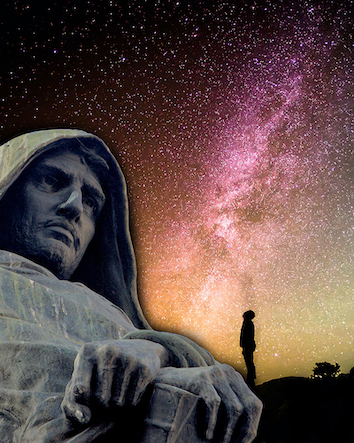
Image Credits: BY Sgadò Walter: Wikimedia Commons | CC BY-SA 4.0

What do you think?