Emperor Julian: Apostate or Hero of Philosophy? – Part 2
Article By Stjepan Palajsa
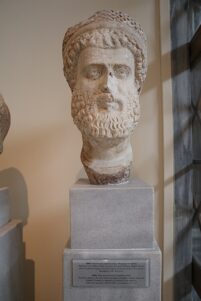 In Part 1 we saw the biography of this extraordinary but forgotten figure of Roman history. This article concludes with an examination of Julian’s philosophical ideas and inner life.
 A soul incapable of feeling fear
Julian followed the great philosophical ideas under the guidance of his teachers, with a particular focus on ethical ideas. These taught him to completely control his body and psyche. He led a simple, almost ascetic life, hard on himself and gentle towards others. He always slept on a simple straw mattress in a cold room, so it was easy for him to endure the winters of the northern territories. He rarely overate. His food was frugal and without seasoning; he rarely ate meat, and if he did, it was only during official celebrations. He disdained wealth and avoided all kinds of luxury, not allowing himself to give in to desires and passions. He stoically endured whatever life placed before him. He was never mastered by anger, bad moods or revenge. He always tried to develop and improve himself. He would not allow others to treat him as a master, because no free man could be the master of another human being. He disdained those who went to temples only to see the Emperor rather than to pray. He demanded that deities be worshipped, not men.
Once he was sure of something, it was difficult to make him abandon his idea unless he was honestly convinced that he was wrong. Some considered this a difficult character trait, while others simply saw it as consistency. He did not allow merchants to sell their goods at exorbitant prices and he purged the administration of corrupt officials.
He spoke concretely and openly. Rather than the pleasures of secular life, he preferred for himself the ideals of the classical heroes and philosophers. He himself said that he was given “a soul incapable of feeling fear”. It is unlikely that in all of human history there have been many men of such upright and heroic spirit. In the entire Roman era, only Marcus Aurelius can be compared to him in terms of moral integrity. However, despite all his greatness, he considered himself only a humble disciple of his teacher.
The son of Helios
Julian was initiated into the Mysteries of Helios-Mithras, the deity of the Sun. With his initiation, he also assumed the responsibility of not revealing the knowledge of the mystery to the uninitiated.
For him, Helios was not only the visible Sun. He was also, in a way, a living being who, like man, participates in the three planes of existence: intelligible (the plane of divine ideas or gods), intellectual (the realm of human reason) and material. Helios was also the incarnation of the Platonic Supreme Good, the solar Logos, the common Father of the souls of all human beings, since physical parents only give the body. Julian believed that everything he did served to direct his soul and the souls of those under his care towards that Supreme Good, so that they might finally be united with it.
“I am a follower of King Helios. And of this fact I possess within me, known to myself alone, proofs more certain than I can give.” (Julian, Hymn to King Helios)
Requiescat in pacem (Rest in peace)
“The best of men has died, he who aspired to the perfect life. The honour of the good also died with him: here insolent bands of villainous and lawless people are already spreading… The restorer of sacred laws has died, he who established beauty in place of ugliness, brought life to our temples, raised altars, united the legions of priests once hidden in the shadows, erected the broken statues… He died too soon, when we had barely had time to feel the good he was capable of doing in the world, and we had not yet been able to take our fill of his spirit. For us, he was like the Phoenix, flying over all lands; but he did not tarry in fields or temples, so we human beings never caught a clear glimpse of him. And now, it is as if the happiness he gave us has vanished; nothing allows it to take root here, because I am convinced that evil has made up for its defeat by triumphing over good once again. It would have been better for us to continue living in this darkness, without knowing the harmony that comes from its sovereignty, than to fall back into the darkness of before, after the luminous example of his life.” (Libanius, Funeral Oration on the death of Emperor Julian).
With Julian’s death, the idea of the Roman Empire also died. The culture of antiquity, after experiencing its second twilight, entered into millennial darkness. Faith in reason and in man disappeared. Ethics, logic and dialectics were expelled forever from the sphere of Hellenic social life. Uniformity was preached and the richness of differences and the right to inner freedom of man were destroyed.
Works by Emperor Julian
Hymn to King Helios
Against the Galileans
Misopogon (The Beard-Hater)
Letter to the Athenians
Several letters (e.g. to a priest, to Theodore, to Evagrius, etc.)
Image Credits: By George E. Koronaios | Wikimedia Commons | CC BY-SA 4.0
Related posts:

Image References
By George E. Koronaios | Wikimedia Commons | CC BY-SA 4.0
Permissions required for the publishing of this article have been obtained
What do you think?