Emperor Julian: Apostate or Hero of Philosophy? – Part 1
Article By Stjepan Palajsa
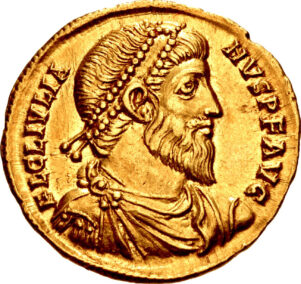
Emperor Julian
The dust of oblivion has erased the memory of one of the greatest figures in European history, whose ideas and work left a profound mark on the world: the Roman Emperor Julian, named ‘the Apostate’ by the Christians to whom his memory was anathema.
By the 4th century AD, Rome had almost completely exhausted its spiritual energy. That immense social body was no longer animated by its former centralizing power, through which all differences were united in a living and functional entity. Now, instead of complementing each other as part of a harmonious whole, differences multiplied and caused friction along national, religious and ideological lines. The vision of the Empire, based on community and an essential equality, had almost disappeared.
In an attempt to reawaken that spirit and its pagan values, Julian searched the libraries and academies of antiquity, in order to immerse himself in their philosophy, ethics and logic and use them as a foundation for restoring the values that had made Rome what it once was.
Biography
Flavius Claudius Julianus was born in 331 AD in Constantinople (now Istanbul). His father, Julius Constantius, and the Emperor Constantine the Great were half-brothers on their father’s side. After Constantine’s death in 337 AD, the new emperor, his son Constantius II, fearing for his throne, had most of his close male relatives assassinated. Among them were Julius Constantius and his eldest son. The only ones who survived were Julian and his older brother, Galus, because they were only children at the time.
However, Constantius exiled them to a remote estate in Cappadocia, where they had no contact with social life. There, in complete isolation, they lived out their childhood and youth. No one was allowed to approach them. They were educated among servants and slaves, under the strict supervision of their tutors. However, in his youth, secretly and under the influence of Neoplatonic teachers, Julian embraced his classical cultural heritage, completely rejecting his forcibly adopted Christian faith. “May oblivion cover that darkness,” he later wrote, referring to those times.
As the emperor Constantius had no children, in 351 AD he summoned Galus to court, where he gave him the title of Caesar of the western provinces, marrying him to his sister Constantina. Julian was then freed from his isolation and spent the following years travelling through Asia Minor and Greece, learning from the greatest Neoplatonic philosophers of the time: Edsius of Pergamon and Maximus of Ephesus, accepting the latter as his teacher and treating him with the utmost respect throughout his life.
Four years after his appointment as Caesar, driven by fear and envy, Constantius had Galus assassinated, and thus, of all his close male relatives, only Julian, whom Constantius had seen only once in his life, remained. Although Julian tried with all his might to distance himself from the court, where his life was in constant danger, a year later he was summoned to receive the title of Caesar in place of his brother. With the title, he was also given the hand of Helena, Constantius’s second sister, in marriage.
Remembering his brother’s fate, Julian saw this as more of an elegant death sentence than a true rehabilitation and transfer of power. As he himself said, this title brought with it the most grievous and difficult slavery. Constantius surrounded him with spies and guards; everyone who had any contact with him was strictly controlled and under continuous surveillance.
With great effort, he managed to bring four of his former servants into his service. Only one of them knew the secret of his worship of the classical deities, and sometimes they performed rites in secret.
Determined to get rid of Julian, Constantius dressed him in a brilliant uniform and, in the middle of winter in 355 AD, with no military experience whatsoever, sent him to the northern provinces, to the land of the Celts. Constantius himself had practically abandoned these territories to the barbarians. The legions assigned to this area were tired, demoralized by constant fighting, had not been paid for months, and lacked food and weapons. Discipline was at an all-time low, and the mere mention of the barbarians was enough to terrify the soldiers. Such was the situation that Julian found when he arrived, not as commander, but subject to the local commanders. Julian’s only duty was to wear Constantius’s royal robes and carry his image among the soldiers.
However, Julian’s reputation grew among the troops. His philosophical principles had taught him to endure any adverse circumstances. Although he had no military training, he was always on the front line, as a simple soldier, sharing with the others the good and the bad, the cold and the hardships. From the time of his arrival, military actions began to be properly conducted and ended that year with success.
Driven by fear, Constantius began to suspect Marcellus, the commander of the army, and ordered him to be eliminated. Convinced that Julian was weak and incapable, he handed him complete command of the army in Gaul in 357 AD.
Despite having no military training, through his personal example and his quick and brilliant actions, he won the trust of the army and one victory followed another. More than forty cities that had been lost were returned to the Empire, and he restored the values of civilization, peace and security in them. He reduced the heavy taxes imposed by the administration and granted positions of responsibility to the most honourable and capable men. Events seemed to unfold in a miraculous aura, as if the deities he worshipped were responsible for shaping a part of history through their incarnation in Julian. Nothing seemed impossible.
The barbarians were expelled from Gaul. He brought two hundred ships from Britain and built another four hundred in less than ten months. He penetrated the Rhine River and established control over the surrounding territories. He also earned the respect of the barbarian peoples, not only by demonstrating his ingenuity, but also through numerous examples of honour and justice. All this time he faithfully served the murderer of his relatives, obeying his laws.
His unexpected success once again aroused Constantius’s envy. That is why he gave him an order that was almost impossible to carry out. Julian’s best and bravest troops, without exception, were to leave Gaul and, in an incredibly short time, report to the border of Persia. The aim was to disarm Julian, and incidentally the whole of Gaul, leaving it at the mercy of the barbarians so that they could do his dirty work.
Julian prepared the legions for the journey, but at dusk, when they were due to leave, the army surrounded the place, rebelled against Constantius and demanded that Julian proclaim himself Emperor. However, Julian was reluctant to accept this role. According to legend, the Genius of the Empire had to appear to him in a dream to demand that he accept the title. This occurred in 360 AD, near Lutetia, now Paris.
Even after this episode, Julian did not want to confront Constantius and did not consider himself Emperor. He only wanted to be allowed to remain peacefully with his army in Gaul. He asked all his legions to send a letter to Constantius in conciliatory terms. But Constantius bribed the barbarians to make life difficult for Julian’s army by attacking them continuously and keeping most of his soldiers busy. Meanwhile, he himself prepared to go to Gaul. When Julian, aided by prophetic signs, discovered this, he decided to take his army directly to Constantinople. “It is not only my own salvation that is at stake, but the welfare and freedom of all men, especially the Celtic people, who have already been betrayed twice by Constantius.”
Accustomed to impossible missions, “travelling at breakneck speed and flying like the wind”, his legions arrived in early winter 361 in Illyria, near Nissus (today Nis, in Serbia) and awaited the decisive confrontation with Constantius. But that almost certain civil war was averted by the sudden death of Constantius.
Legally – and almost miraculously – becoming Emperor, Julian began working on the complete restoration of the Empire. It seems as if he felt that he did not have much time left and that before he left he had to resurrect the fallen giant. He worked tirelessly day and night. The sacred idea of Rome as a place of peace and tolerance, where all peoples and all religions could exercise their rights and aspirations, was his guiding star through the chaotic labyrinth of his time.
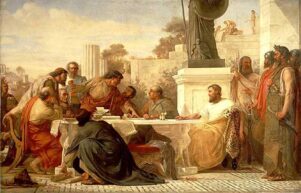
Julian the Apostate Presiding at a Conference of Sectarians.” Oil painting by Edward Armitage (1817-1896).
We see him acting in different roles: as emperor, high priest, legislator, judge, military commander, economic reformer and simple soldier. His personal example was a model of behaviour. In his dreams, he was visited by the ‘Genius’ of the Empire, which encouraged him to continue his duties as emperor, whose sole mission was to look after the welfare of his subjects. He cleansed the institutions of swindlers, thieves, flatterers, conspirators and parasites. He restored tolerance and freedom of religious worship, even for those who did not accept it for others.
In the autumn of 362, Julian arrived in Antioch, where he planned to prepare his campaign against the Persians. There he experienced one of his greatest disappointments, as he became fully aware that the Hellenic spirit he had idealized was far removed from that which had existed in the times of Homer or Plato. The Hellenes no longer “preserve the image of ancient virtue”, he says in a letter. Instead, he praised the Celts, Illyrians and Germans, whom he called his spiritual kinsmen. His letters continually reveal his nostalgia for that ‘barbarian’ Europe.
On his way to Persia, his small but brave army won battle after battle, but in the course of one battle Julian received a mortal wound to his chest. His last thoughts and prayers were directed to the deity to whom he felt devoted: Helios.
Stjepan Palajsa is Director of New Acropolis in Slovenia
Image Credits: By Classical Numismatic Group | Wikimedia Commons | CC BY-SA 2.5, By Walker Art Gallery, National Museums Liverpool | Wikimedia Commons | CC BY PD
Related posts:


Image References
Featured image : By Classical Numismatic Group | Wikimedia Commons | CC BY-SA 5.0 Image 2; By Walker Art Gallery, National Museums Liverpool | Wikimedia Commons | CC BY PD
Permissions required for the publishing of this article have been obtained
What do you think?