Beyond the Arrow of Time: Quantum Physics, Philosophy and the Courage to Align
Article By Laszlo Balizs
 Classical physics presents a world that feels reliably ordered: first comes the cause, then the effect. If you push something, it moves. Time flows forward like an arrow and reality unfolds step by step.
This view shaped not only science but civilization itself. Law, responsibility, morality, planning and identity all follow the same pattern: past, present and future. We learn from the past, act in the present and look forward to the future. For centuries, this picture worked remarkably well. And then physics began to notice something odd.
At the quantum level, some experiments show that the usual “first this, then that” order does not always hold. In delayed-choice and entanglement experiments, particles act in ways that seem to depend on how they will be measured later. When scientists choose how to measure a particle after it has already entered an experiment, that decision appears to affect how the particle acted before. It is important to note that this does not mean particles somehow “know the future”, or that we can send messages back in time. Physicists are cautious about these ideas and for good reason. What the experiments reveal is more subtle and even more puzzling: reality might not be fully explained as a series of separate moments marching forward through time.
A clear example of the tension between order and randomness is the delayed-choice experiment, first suggested by physicist John Archibald Wheeler[1]. In a modern version of this experiment, a single photon goes through a device where it can act like a wave, showing interference, or like a particle, showing a clear path. The key point is that the decision about how to measure the photon is made only after it has already entered the device.
The observed outcomes are consistent with the later measurement choice. If the setup is made to detect wave behaviour, interference shows up. If it is set to detect particle behaviour, the photon acts as if it took only one path. What is unsettling about this experiment is not that the photon “changes the past,” but that its behaviour cannot be fully explained as having been decided earlier.
These experiments show that quantum events make the most sense when viewed as a whole. Some interpretations of quantum mechanics also suggest that events are part of one connected process, not just a series of separate causes and effects. From this point of view, time is less like a straight line and more like a whole, where how things are connected matters more than the order in which they occur.
This idea does not remove time from our daily lives. However, it suggests that linear time might just be an approximation, not the complete picture. Physics may not tell us how to live, but it does question the idea that time always moves in a single, straightforward direction. When we start to question that, philosophy can step in and ask a different question: if time is not only horizontal, how should we think about it?
Another metaphor can help: vertical alignment.
Rather than seeing moments lined up one after another, we can picture layers of meaning, intention, memory and potential all existing together. We do not experience everything at the same time, but everything might be available all at once. In physics, this appears in time-symmetric descriptions and block-universe models. In philosophy, the idea has been around much longer.
Plotinus described time as not merely a physical dimension. In his Enneads, he states: “Time is the life of the soul in movement.”[2] For him, eternity does not mean endless time. Instead, it is a state of wholeness: “A life that is at once whole and complete.”
Time starts when that inner wholeness is stretched into a sequence, as we move from one desire to the next, from one fear to another, or from one distraction to the next. Simply put, the more divided we are inside, the more fragmented time feels. But when we become internally aligned, when our thoughts, values and actions start to agree with each other, something changes. We feel less scattered, less pulled by the past and less anxious about the future. Life feels more whole.
Augustine of Hippo[3] views time in his own way but arrives at a similar insight. He starts with honesty: “What then is time? If no one asks me, I know; if I wish to explain it, I know not.” He points out something simple but powerful: the past no longer exists and the future has not yet arrived, yet both are present within us. The past lives as memory. The future lives as expectation. What we call “time” is deeply tied to consciousness.
He describes time as a stretching of the soul. Regret pulls us backward and worry pulls us forward. We rarely find full rest in the present.
While modern physics explores new ideas through mathematics, philosophy has long been asking similar questions about existence. And psychology sits right at the crossroads of these two fields. When people look back on tough moments from their past and give comfort, understanding or reassurance to their younger self, they are, in a real way, showing up across time. The adult self brings perspective, strength and compassion to a moment that once lacked these qualities.
Healing does not come from changing what happened, but from realizing that support was always available from within. Healing is not about returning to the past. It is about becoming whole in the present. This process works because the mind does not experience time in the same way that clocks do. Traumatic memories are not just “in the past”, they feel present whenever they come up.
Seen in this way, therapy shows that the present self can influence the meaning and emotional reality of the past. The event stays the same, but what changes is the story we tell ourselves, how we feel about it and even how our bodies react. Modern psychology shows that memory is not a fixed recording. Instead, it is a dynamic process. When we look back on an experience with new understanding, our internal view of that event changes. Once again, we see a connection with physics, not as proof, but as a parallel.
This does not mean that physics has confirmed any spiritual theory of time. Equations cannot tell us how to shape our inner lives. However, they suggest that viewing time as a series of separate moments might not be the whole story. When we let go of that strict view, philosophy and psychology can look into a deeper idea: maybe coherence matters more than sequence.
There is another side to this idea that people don’t talk about much, but it’s very practical. When people talk about “being aligned,” they usually mean that their values, actions and inner life match up. But alignment is more than just being consistent with yourself. It brings up a deeper question: what are you aligning to?
In philosophy in the classical tradition, the answer is not simply “to yourself,” but to an Ideal. Plato described the Good as something above personal opinion. Plotinus saw unity as a return to what is whole. An Ideal is not just a fantasy. It is a direction… choosing truth over falsehood, courage over fear, justice over convenience and wholeness over fragmentation. When we align with an Ideal, we guide our lives toward something steady. This helps reduce inner conflict, because our choices are based not only on what we like, but also on our principles.
Discipline here isn’t about being rigid. It is about staying true to yourself over time and not doing things today that you will regret tomorrow. Sometimes, you have moments of clarity where it feels like your “future self” is right there with you. Suddenly, you know what you need to do. The right choice is clear, even if it’s hard. People often call this intuition, conscience or inner guidance.
From a scientific point of view, this is just your brain recognizing patterns over time and using your experiences. That makes sense. But if you look at it philosophically, there is another way to see it: the more integrated and honest your inner life becomes, the more future-oriented wisdom becomes available right now. It’s not that the future is sending messages back to you. Instead, when you are aligned, the gap between who you are and who you want to be gets smaller. With less inner conflict, your decisions become clearer and your present and future selves start to match up.
You don’t have to give up science or believe in anything mystical to see this. Instead, it asks for something quieter and harder:
- cultivating an inner life,
- maintaining dialogue with oneself,
- being honest, disciplined and caring,
- not letting yourself become divided over time.
If everything in the world is more linked than we thought, then integrity is not just about being good. It is about being true to how things really are. Alignment is not just a self-help idea; it is a way of living that aligns with how the world actually works.
Modern physics doesn’t tell us how to live, but it does challenge the idea that life is just a series of separate moments.
Perhaps the future cannot go back and change the past. What guides us may not be the future as a moment in time, but the Ideal as a direction. When we orient ourselves toward something greater than impulse, we do not need time to move backward. The axis is present now. If we pay attention, the best parts of who we are becoming may already be shaping the choices we make now.
And that, in itself, is extraordinary.
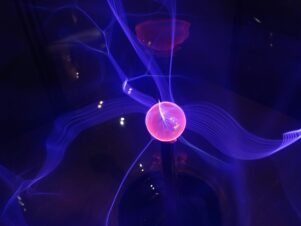
Image Credits: By Fractal Hassan | Unsplash | CC BY PD
Related posts:




Image References
By Fractal Hassan | Unsplash | CC BY PD
Permissions required for the publishing of this article have been obtained
Article References
[1] Wheeler’s Delayed-Choice Proposal Wheeler, J.A., “The ‘Past’ and the Delayed-Choice Double-Slit Experiment,” in Mathematical Foundations of Quantum Theory. Ed. A. R. Marlow (New York: Academic Press, 1978), 9–48. [2] Plotinus, Enneads, III.7 (“On Eternity and Time”), trans. A. H. Armstrong, Loeb Classical Library (Cambridge, MA: Harvard University Press, 1966) [3] Augustine, Confessions, Book XI, trans. Henry Chadwick (Oxford: Oxford University Press, 1991).
What do you think?