
The Art of Happiness
Author: Sabine LeitnerJuly 24, 2026
“Are you happy?” “Well, sort of happy.” “Would you like to be happier?” “Hm, I don't have time to ask myself this question. What does happiness mean anyway?” “Good question.” Do we mean by happiness this temporary moment of a pleasant day, a nice event or winning the lottery? Because even the happiness derived from gaining a large sum of money is temporary – [...]
The Timeless Spirit of Sport
Author: Sofia VenutiFebruary 28, 2026
Sport is not only formative for individuals, but is also a social and global concept which includes the responsibility for human development through everyday activities. In fact, some of the greatest ancient philosophers recognized the importance of developing a harmoniously balanced personality where physical education and sport played a significant role. In the West, Socrates, Plato and [...]
Rhetoric: The Art of Persuasion
Author: Istvan OrbanMay 26, 2019
“I have a dream...”, “In this grave hour...”, “I do not come here as an advocate…” – the first lines of some of the greatest speeches that shaped the history of the 20th century. Rhetoric as the art of persuasion has always played an important role within societies. It is the main tool in all kinds of debates and the key technique for persuading a large audience. It is used by [...]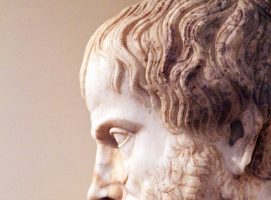
Aristotle – the Ethics of Happiness
Author: Julian ScottFebruary 7, 2017
One of Aristotle’s most famous works is his Nicomachean Ethics, so called because the work was edited by Aristotle’s son Nicomachus. It is a curious fact that none of Aristotle’s surviving works were directly written by him. They are all compilations from his lecture notes, edited by his various students. This accounts for their often dry style, in contrast to the writing style of his lost [...]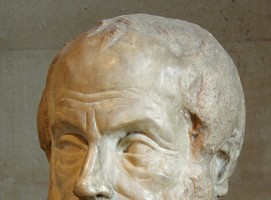
Aristotle
Author: AnonymousAugust 7, 2014
We owe to the Greek historian Diogenes Laertius most of our information on the life and works of this philosopher, who, together with Socrates and Plato, symbolize Western philosophical inquiry. He was born in 384 B.C. in Stagira (Thrace) and died in Chalcis (Euboea) in 322 B.C. His father, Nicomachus, was physician to Amyntas, the father of Philip and king of Macedonia. On the death of [...]
The Inner Gold of the Alchemists
Author: Julian ScottMay 12, 2014
Alchemy seems to be an almost universal science. Not only do we find it in Medieval Europe, but also in China and India, amongst other places. This is perhaps because it is not just a primitive forerunner of modern chemistry, but a sacred science in its own right, which was studied wherever esoteric knowledge has appeared. The first thing I would like to do is to sweep aside the false image of [...]