The Art of Happiness
Article By Sabine Leitner
 “Are you happy?”
“Well, sort of happy.”
“Would you like to be happier?”
“Hm, I don’t have time to ask myself this question. What does happiness mean anyway?”
“Good question.”
Do we mean by happiness this temporary moment of a pleasant day, a nice event or winning the lottery? Because even the happiness derived from gaining a large sum of money is temporary – apparently after one year, people are exactly as happy as they were before. In other words, do we mean by happiness something that depends on external things, like events, people, the weather, holidays, etc.?
If yes, then we all know that these moments of exalted emotional happiness will inevitably pass, and then… what? Back to what we call our ‘normal’ life. And what if this life does not make us happy? Shall we then try to chase after these fleeting moments of happiness? It has often been said that the search for happiness is one of the main sources of unhappiness in the world.
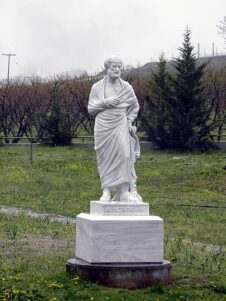
But isn’t happiness the goal of life? It depends. Aristotle, the Epicureans and the Utilitarians all agreed in some way that happiness was the goal or highest good in life. But they all understood different things by ‘happiness’. For the Utilitarians it meant ‘pleasure and absence of pain’ but this is ultimately a passive state. If this passive kind of happiness would really make us happy, we could just pour a happiness-inducing drug into the world’s water supplies and keep everyone ‘happy’. But the fact that this ‘solution’ does not really appeal to us shows that this would ignore a very important aspect of our human nature: our need to strive, to grow, to improve, to discover and to create. Of course, not all our striving has brought us perhaps what we wanted, but we would not be able to live a truly human life without the freedom to explore, to learn, to make mistakes and – more often than not – achieve the intrinsic goods of knowledge, progress and wisdom.
For the Epicureans, happiness also included friendship, freedom from mental disturbance (ataraxia) and autarky (self-sufficiency) – inner states we can contribute to and practise, and which are ultimately within our control. And Aristotle said that every action we undertake (even doing the washing up) aims at some good, but that the highest good was eudaimonia. This is often translated as ‘flourishing’ but etymologically it consists of eu (good/well) and daimon (spirit/deity), which means literally ‘a state of good spirit’ or ‘living with a good guardian spirit’ or the feeling of being ‘watched over by a good angel’. For Aristotle, eudaimonia is achieved when we live by using and developing our highest faculties and are in alignment with our values.
These last examples point to a happiness that is independent of outer circumstances and to something that can be practised and mastered. If we understand that everything in life needs to oscillate between two poles, otherwise life would disappear, and that we wouldn’t even know what happiness was if we didn’t know pain and discomfort; then we can accept that there has to be rain and sunshine, good and bad, success and failure, harmony and conflict. We can train ourselves to see the positive or meaningful side of things, we can practise reflecting on the timeless wisdom of Epictetus that ‘good and bad are not in things but how we see them’. Through reflection and intentional thoughts, habits and actions we can reach a positive inner state that will contain, amongst other things, acceptance, gratitude, awareness and meaning.
We can either make the futile attempt to arrange the world to suit us, or we can train ourselves to attain the inner freedom to remain calm and steady within the world and not be overwhelmed by difficult circumstances.
This kind of happiness is not as intense as the exhilarating joy of a fun day out, but it is more stable and lasting and can even coexist with pain and suffering. It is about being at peace with life as it is and not trying to change life to how we wish it to be. The beautiful poem At Peace by the Mexican poet Amado Nervo expresses exactly this sentiment. He wrote it towards the end of his life, and its last two lines have become a real inspiration for my own inner practice of the art of happiness:
“I loved, I was loved, the sun touched my face.
Life, you owe me nothing. Life, we are at peace!
Image Credits: By Carole Raddato | Wikimedia Commons | CC BY-SA 2.0
Related posts:
Permissions required for the publishing of this article have been obtained
What do you think?