
The Depth of Courage
 Courage is often imagined in the language of spectacle: the soldier charging into battle, the firefighter rushing into flame, the dissident standing before a hostile crowd. These images are vivid because they are visible. They lend themselves to narrative, to applause, to history. Yet there exists a quieter and more subtle form of courage – one that can happen much more frequently than these outwardly heroic acts, and yet rarely earns recognition despite often being more demanding than any outward act. It is the courage required to face oneself, the point where the ‘inner battle’ occurs.
The inner battle is not merely metaphorical. Human beings are, in a profound sense, divided beings. We harbour conflicting desires, competing values and impulses that do not always align with our ideals. The ancient philosophers understood this well and often described the soul as a terrain of tension: reason striving for order, appetite pulling toward indulgence and our soul oscillating between the two. Courage, in this inward domain, is about confronting the unsettling realization that the adversary is, in part, oneself.
This confrontation requires a particular kind of honesty. It demands that we look directly at our own vices or negative habits – not as abstract moral categories, but as living tendencies within us. Pride, envy, resentment, cowardice, self-betrayal: these are not merely words but patterns of thought and behaviour that shape our lives. It’s difficult to admit to them, but useful to reflect on these patterns and see them as something that we human beings share. The difficulty lies in the fact that the mind is adept at concealment. We rationalize our actions, reinterpret our motives and construct narratives that preserve a flattering image of ourselves. To pierce through these defences is already an act of courage.
Why should such honesty be frightening? Because it destabilizes identity. Most of us carry an implicit sense of who we are: a coherent story that provides continuity and meaning. To acknowledge the presence of darker elements – like pettiness where we believed there was generosity, or fear where we imagined confidence – threatens this narrative. It introduces ambiguity and discomfort. Courage, then, is not only the willingness to see the truth, but the willingness to endure the disorientation that follows.
Yet recognition alone is insufficient. The deeper challenge lies in transformation. To conquer one’s vices or emotional and psychological habits in this lifetime might mean not to eliminate them entirely – a task that may be impossible – but to refuse their governance. This requires discipline, patience and a sustained effort to act against ingrained tendencies. Consider the person prone to anger, envy or arrogance. The courageous response is not simply to admit this trait, but to interrupt its habitual expression inside of oneself (not merely external expression, as that would simply be suppression): to pause, reflect, to see that millisecond moment as a threshold in the personal trial, an opportunity for intuitive discernment to choose to feel, be and act differently even when reaction feels inevitable. Such moments are rarely dramatic like the outwardly heroic acts. They occur in the privacy of our hearts, in the split second between impulse and action. In fact, the word courage comes from the Latin ‘cor’ (heart) and ‘agere’ (to act). What makes us act with courage isn’t the heart of fleeting emotions, but, as Delia S. Guzman called it, the “heart which resonates with the harmony of the universe, which knows how to stand together with other hearts” and knows how to stand up to the ego and the mind of desire.
So, courage involves a form of integration, begun by understanding that our darkness arises from the same soil as our virtues. The capacity for anger, for instance, is linked to a sense of justice; arrogance is linked to the desire for recognition which can motivate achievement. Courage, therefore, is not about annihilating these traits, but of understanding and harmonizing them.
The inner battle is not a war of destruction of our emotions or ego, but a process of integration and alignment. The courageous individual does not deny the existence of conflicting drives but seeks to harmonize them under a guiding principle. This principle might be reason, conscience, a commitment to certain values, the belief in a higher self beyond the mind or the deep understanding of your being’s unity with the universe on the path of evolution, oneness. Whatever its form, it provides a standard against which impulses can be understood and, when necessary, restrained and reshaped.
This restraint should not be confused with suppression. Suppression buries what’s deemed unacceptable, driving it underground where it may re-emerge in distorted ways. Courageous restraint, by contrast, is conscious and deliberate. It acknowledges the impulse while choosing not to act upon it. This distinction is subtle but crucial. It preserves awareness and agency, rather than forsaking them.
The cultivation of this inner courage is a gradual process. It cannot be achieved through a single act of will. Instead, it unfolds through repeated encounters with oneself. Each instance of self-examination, each moment of resisted temptation, contributes incrementally to a more integrated character. Over time, these small acts accumulate, shaping habits and reinforcing a sense of moral agency.
Importantly, failure is inevitable. No one consistently triumphs over their weaknesses. There will be lapses, falls and moments of failure. Here, too, courage plays a role. It is required not only to confront one’s flaws but to persist in the face of imperfection, not surrender to defeat. Without this resilience, the project of self-mastery collapses into denial or despair. Courage allows for a middle path: an honest acknowledgment of failure coupled with a renewed commitment to improvement.
One might worry whether this inward focus risks becoming self-absorbed. Does the preoccupation with your own vices distract from engaging with the world? Well, if self-examination becomes an end in itself, it can indeed devolve into narcissism. But if it is understood as a means to ethical living, it acquires a broader significance. The person who has cultivated inner courage is better equipped to act with integrity, to resist harmful impulses and to respond thoughtfully to others. In this way, the private struggle has societal consequences.
Inner courage also underpins other forms of courage. The individual who cannot face their own fears, biases and limitations is unlikely to stand courageous in external crises, or even arguments with others. On the other hand, the one who has practised self-confrontation develops a kind of steadiness. They are less dependent on external validation, less swayed by fleeting emotions and more capable of acting in accordance with their principles. The visible acts of bravery that society celebrates often rest upon this invisible foundation.
In an age that prizes self-expression, there is a temptation to equate authenticity with the unfiltered expression of whatever one feels. But this conflates honesty with impulsivity. True authenticity requires discernment: the ability to distinguish between what arises within us and what deserves to be enacted, what harmonizes and aligns with our Natural Law, with our Dharma. Courage is essential to this process, for it enables us to resist the immediate pull of impulse (from our desires or fears) in favour of a response which comes from our Higher Self. This discernment is being able to see what is essential: in that moment, we have to filter out the distracting senses and personality to see what’s essential for the path of our character and our soul. Exercises of concentration help us train our will and our attention so that we can better see what is essential for us to change in these moments.
Ultimately, the virtue of courage, when turned inward, reveals itself as a commitment to truth and transformation. It is the willingness to see oneself clearly, to accept the discomfort of that vision and to undertake the slow but determined work of change. It is neither glamorous nor easily recognized. It does not lend itself to grand narratives or public acclaim, as these could simply stroke the ego again. And yet, it is the most important form of courage we can cultivate, the one we find behind the veil in myths and fables.
For in facing the darkness within, we do not merely overcome vices; we reshape the very structure of our character so it can become a more aligned vehicle for our soul to flourish. We become, in a deeper sense, responsible for who we are, and in that responsibility lies a quiet but profound form of freedom – not from struggle or pain, but the freedom of the conscious Self.
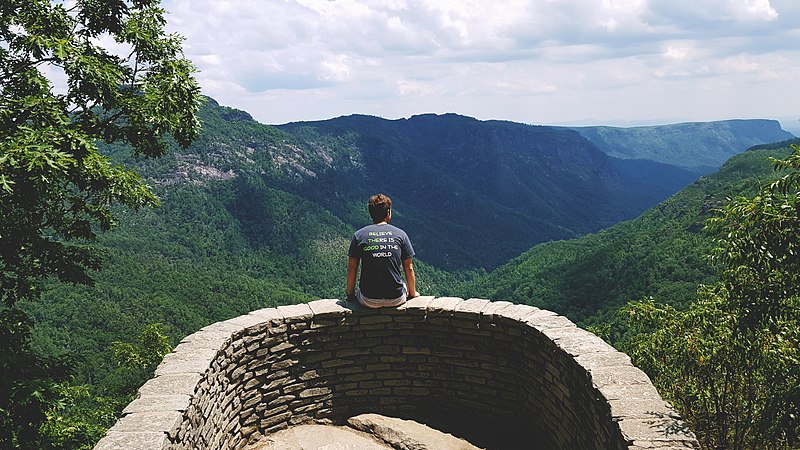
Image Credits: By sasint | Pixabay | CC BY PD



What do you think?