Pachamama, Goddess of the Earth, the Universe, the All
Article By Natalia Lema
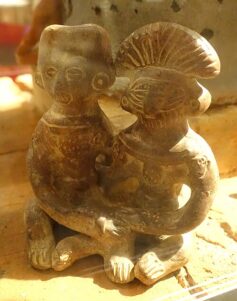
Pachatata and Pachamama
These days, I often hear about the need to go back to our roots and reconnect with nature. It feels as though we have allowed speed and productivity to take over our daily lives. In recent years and knowing I grew up in a city, I have started to shift from simply observing nature’s beauty to feeling part of it, rather than standing outside of it. It makes a difference whether we see nature as something to control and manage, or as a living presence we are part of.
I first heard the name Pachamama in primary school, when learning about different cultures and their deities. She was introduced as a figure of great importance in the Andean tradition. The Andes, the longest continental mountain range in the world, have always felt familiar to me, as I grew up in Colombia. There, the Andes are not just a single range, but a rich and biodiverse system that shapes the country’s geography and life.
Pachamama is often translated as “Mother Earth,” but this translation only captures part of her meaning. The word pacha can also refer to the world, the universe, space, time, or even an entire era. In this sense, Pachamama can be understood as “Mother of the cosmos,” a concept that already invites a deeper reflection on how reality itself is perceived. Pachamama does not have an origin story like many other myths do. As I searched for the story of creation behind her, what I found was more a way of understanding reality and seeing how nature is sacred and always alive.
In Inca cosmology, Pachamama is a mother goddess and a life giving force that sustains and connects all existence. She is often depicted as a fertile woman carrying harvests such as potatoes or coca leaves, symbols of nourishment and abundance. At the same time, she is considered the origin of fundamental elements such as water, earth, sun and moon. Through this, she becomes not only a symbol of fertility, but of the very structure of the cosmos.
She is portrayed as loving and generous, yet she can also be destructive. Earthquakes or landslides are sometimes understood as expressions of her being neglected. This dual nature, the ability to both give and take away, is not unique to Andean belief. Many mythologies recognize this balance. In ancient Egypt, for example, the goddess Sekhmet embodied destruction and war, while Bastet represented protection and care. These opposites are not contradictions, but complementary forces. Perhaps this reflects something within us as well, as we also carry opposing energies.
From an Andean worldview, Pachamama is present everywhere and in everything. This suggests a deep sense of interconnectedness between all living beings. It is a way of seeing the world that many of us may have forgotten, and perhaps that is why there is now a growing desire to return to it not just intellectually, but through experience.
What I found especially meaningful is how this belief is still alive today. In countries such as Peru and Bolivia, Pachamama continues to shape daily life, traditions and even travel experiences. People honour her through rituals, offerings and festivals, particularly during the month of August. Communities gather to express gratitude by offering food, objects or symbolic items to the earth. These acts are not just tradition; they are a way of maintaining a relationship, of staying connected and of asking for protection.
One idea that particularly stayed with me is the practice of “paying” the earth. Before important moments such as starting a journey, beginning a business or moving into a new home, people hold small ceremonies where offerings are made. On the surface, this may seem like a simple gesture, but it carries a deep meaning. It reminds us that we are not acting alone, and that every step we take is supported by something larger. We do require humility to accept the participation of something divine and to find ways to connect with it has always drawn my attention. How do we embrace the profane and the sacred in the things we do?
Although the Incas had other important deities, such as Inti, the Sun God, Pachamama holds a unique place as the nurturing mother who sustains all life. She fertilizes the fields, ensures abundance, and supports the well-being of communities. Through her, nature is not just a resource, but a relationship. And a relationship, as we know, requires care, respect and balance. Reflecting on Pachamama, she invites us to reconsider how we relate to the world around us and hopefully reconnect with nature by remembering something we have always been part of.
Image Credits: By Daderot | Wikimedia Commons | CC0 1.0
Related posts:


Image References
By Daderot | Wikimedia Commons | CC0 1.0
Permissions required for the publishing of this article have been obtained
What do you think?