The Etruscans: Guardians of the Sacred
Article By Agostino Dominici
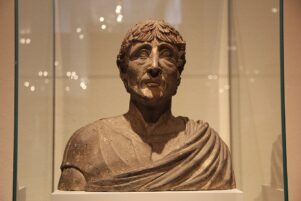
Etruscan Bust of a man from Capua 2 C B.C
The origins of the Etruscans – along with their sacred knowledge, language, and traditions – remain, in part, veiled in mystery. Even in antiquity, people wondered where this enigmatic civilization came from. Herodotus, for example, claimed that during a time of severe famine, the people of ancient Lydia migrated to the fertile lands of the Italian peninsula, where they eventually founded what would become the Etruscan civilization. By the time of Augustus (27 BCE–14 CE), however, this theory had already been challenged by Dionysius of Halicarnassus. In his writings, he argued that the Etruscans had no connection with the Lydians and were, in fact, an indigenous people of Italy. Modern archaeological research conducted over the past fifty years appears to support this view, making it the most widely accepted theory today. Of course, this does not rule out the influence that Eastern cultures had on the Etruscans over the centuries – particularly in art and religion.
Already in the third millennium BCE, the territories of Etruria were inhabited by people (the so-called Rinaldone culture) who observed the sky, built with ingenuity and purpose, and carried out complex rituals. This suggests that the founders of the megalithic astronomical temple (circa 2300 BCE) of Poggio Rota in Tuscany, were probably the true, or at least indirect, cultural ancestors of the Etruscans.
A people deeply steeped in mystical and magical knowledge, the Etruscans heavily influenced Roman civilization (two of Rome’s seven kings were of Etruscan origin). Many traditions thought to have originated with Rome should instead be attributed to Etruscan knowledge. We could mention in this respect: the Roman custom of having both a first and last name, the grid-like city layout (known as Hippodamian plan), the widespread use of the arch found in buildings and walls, and even the famous gladiatorial combats – which were originally part of Etruscan funerary rites.
As early as the ninth century BCE, the Etruscans were already well organized into a confederation of twelve city-states that reflected macrocosm-microcosm correspondences, particularly linked to solar symbolism. Each of these cities was ruled by a priest-king called a Lucumo, who was assisted by a council of wise men that later evolved into a body of magistrates (similar to the Roman praetors), forming the aristocratic and ruling class. These cities, surrounded by massive walls still visible today, were founded with great care, following magico-religious prescriptions, as confirmed by the studies on the foundation of Rome itself. Besides geomagnetic and telluric considerations in choosing the ideal locations, there was also meticulous urban planning. Cities were built following a plan that aligned all the roads with the two main cardinal axes (known as the cardo – north-south – and decumanus – east-west axis).
Etruscan religion was a blend of rituals and symbols originating from the ancient Greek and Latin peoples, with the addition of some uniquely Etruscan deities. For the Etruscans, all human life was permeated and influenced by the sacred. There was always a connection between what is happening on Earth, the gods in the sky and those in the underworld. Particularly interesting is how the Etruscans conceived of their relationship with the gods – a relationship that, unlike that of the Romans, was entirely governed by fate. For the Romans, the relationship with the gods was based on mutual respect and exchange; for the Etruscans, humans had no power against the forces of the gods, to whom they owed complete obedience. From this distinctive religious worldview, it becomes clear why the foundation of Etruscan ritual practices reflected their deep understanding of various forms of divination and mantic arts.
The Etrusca Disciplina was the sacred doctrinal corpus of Etruscan religion, regulating the relationship between humans and gods, through a system of complex divinatory practices. We find, for instance: haruspicy, the interpretation of omens through the entrails of sacrificed animals – particularly the liver; fulguration, which involved reading the signs revealed by lightning and other atmospheric phenomena; and augury, the observation of the flight patterns of birds to discern divine will. Additionally, they practiced extensively oneiromancy, or the interpretation of dreams, and made great use of female prophetesses, known as vegoie – later referred to as sibyls. Another significant element of their divinatory tradition was the widespread use of magical mirrors, which were believed to reveal hidden truths and divine messages.
Staying within this context, the most mysterious and fascinating figure is Tages, the founder of the entire Etruscan religious-divinatory system, identified as a divine child with otherworldly appearance and wisdom, who miraculously emerged from a clod of earth to teach humanity. His birth from the earth, reflects the deep connection the Etruscans had with Nature, with the sacredness of the soil and the legendary enchanted woods where it is said the Etruscan priest-kings annually met.
The vast majority of surviving Etruscan inscriptions are funerary in nature, showing how much care was devoted to matters of death and the afterlife. The Libri Fatales, in some of their sections, speak of the inevitable end that awaits both human life and the life of the state. Their vision of the beyond was complex, populated by both benevolent and malevolent deities that needed to be understood and guarded against. There are many parallels with ancient Egyptian customs. Etruscan tombs were made to look like real homes, and the dead were buried with the things they loved in life. The underworld was a realm that had to be understood in order to navigate it and act appropriately within it. Among funerary texts, we also find the Acherontic Books, which offer funerary instructions and practical guidance to ensure a safe passage for the soul’s journey – a journey that was by no means guaranteed. These ritual practices likely belonged to a corpus of secret knowledge reserved for priestly colleges and mystery rites.
Regarding the disappearance of the Etruscans, it is worth noting that ancient esoteric traditions speak of certain places on Earth acting as portals to other dimensions – mysterious and ‘subterranean’ (i.e. invisible) realms known by various names. The well known myths of Shamballa and Agartha specifically refer to these traditions. Legendary aspects of the Etruscan people and their disappearance are also linked to mysterious ‘portals’ or sacred sites. We can mention, for instance, the Fanum Voltumnae and Lake Bolsena, known in antiquity as the “sacred mirror” of the Etruscans. The Fanum Voltumnae was the federal sanctuary and the most sacred centre of Etruscan power, an oracular centre dedicated to the most important Etruscan deity, Voltumna – an asexual god associated with the metamorphosis of Nature and royal authority.
Aside from the legendary elements – which often veil hidden truths – the answer to the question of how the Etruscans ‘disappeared’ lies in the simple fact that, with Rome’s expansion, they were slowly assimilated into it. The Romans tended to integrate conquered cities organically, often leaving local customs and administrative structures intact. In fact, for many centuries after Rome’s conquest of Etruria, the Etruscans retained a notable degree of autonomy. Up until the 1st century CE, the Etruscans actively engaged with and supported Roman society, contributing their cultural and religious wisdom. In doing so, they became a vital and sacred foundation for what would later become the heart of the Mediterranean world.
Suggested further reading:
Etruschi: il vincolo dell’unità sacrale by Enzo Pecchioni
La Magia Etrusca by Stefano Majorca
Image Credits: BY Gary Todd | Wikimedia Commons | BY CC0 1.0
The entity posting this article assumes the responsibility that images used in this article have the requisite permissions

Image References
BY Gary Todd | Wikimedia Commons | BY CC0 1.0
Permissions required for the publishing of this article have been obtained
What do you think?