The ‘Houses of Life’ – the Wisdom and Mystery Schools in Ancient Egypt
Article By Sabine Leitner
I will never forget a very well-educated friend of mine who once said, with a hint of contempt in his voice, that the Egyptians didn’t have philosophy. He claimed they weren’t worth studying, and this is a view I have heard more than once – that Western civilization was born entirely of Greek and Roman thought.
We now know, however, that the Greeks were deeply inspired by Egypt. Many of the foundational ideas of our civilization were of Egyptian origin and history shows that figures like Pythagoras, Plato, Thales, Hippocrates, Herodotus and Solon went to Egypt to study, often for years at a time. Moreover, as Bill Manley showed in his book The Oldest Book in the World – Philosophy in the Age of the Pyramids, they even had a word for philosophy (see New Acropolis magazine No. 62, The Wisdom of Ptahhotep).
The profound influence of Egyptian thought became even clearer in 2005 when two Egyptology professors published The Book of Thoth, a previously unknown Egyptian religious text. Believing its teachings were too important to be confined to academia, they later published Conversations in the House of Life in 2013, a version for the general public.
The Book of Thoth provides a rare look into the ancient Egyptian esoteric tradition. Structured like a dialogue – most likely between the god Thoth (or a ‘Master’) and a Disciple, known as ‘the-one-who-loves-knowledge’ – it serves as an initiation text into the sacred knowledge of the scribal tradition. The text covers a wide range of subjects, from practical instruction on how to hold a writing brush, through the symbolic meaning of scribal tools, to a detailed description of sacred geography. It is mentioned that the text was produced within the House of Life.
We know very little about these Houses of Life, partly due to the secrecy surrounding them and the advice against disclosing their teachings. However, research over the past few decades has confirmed their existence as advanced training centres for a vast array of professions, including scribes, priests, physicians, veterinarians, astronomers, diplomats, translators, musicians, sculptors, architects and poets. It is likely that these centres were the model for the Greek Mystery Schools and philosophical traditions. Their name, Per-Ankh (or Anx), comes from the hieroglyph combining the symbols for ‘house’ and the ankh. It is said that they were places where “human beings were brought to life”. In Amarna, excavators found a building with bricks stamped with the hieroglyphs for the ‘House of Life’:
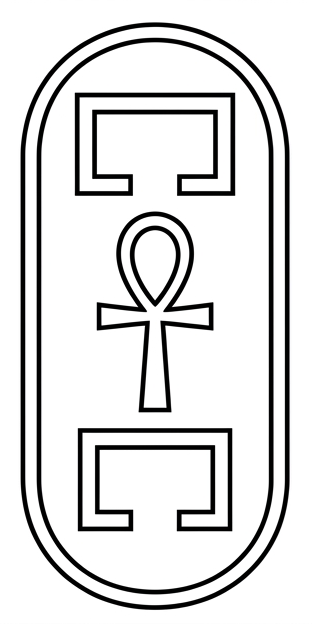
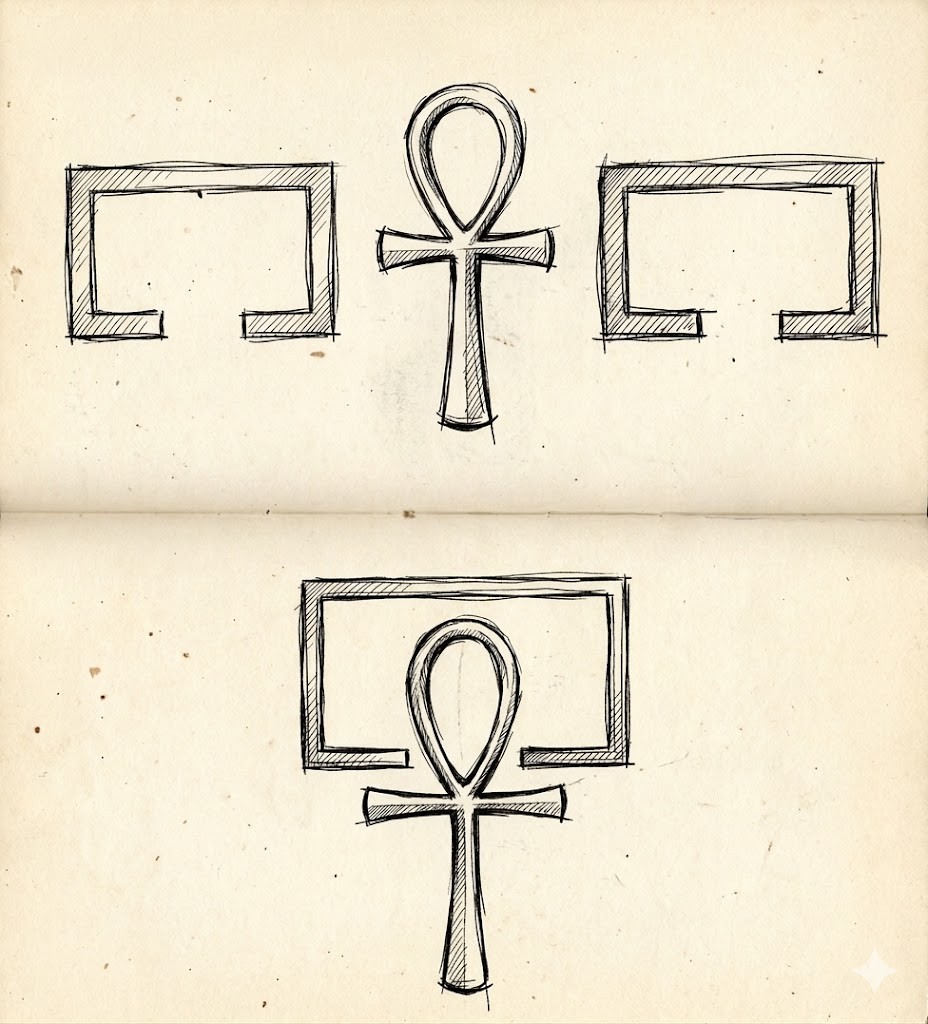
The oldest references to a House of Life date from the Old Kingdom (about 2200 BCE). Although only two archaeological sites of the Houses of Life have been identified so far, we know from texts that they existed in many cities, and in the Late Period there may have been a House of Life in each of the main temples throughout Egypt.
These institutions were integrated into larger temple complexes, or in some cases adjacent to palaces. They can be seen as ancient ‘magical-spiritual universities’ for the preservation, transmission and creation of knowledge, much like our modern universities, which store, preserve and transmit and create new knowledge through their research and studies.
In the Late Period and the subsequent Greco-Roman Period, the term ‘House of Life’ may have been used more broadly to refer to a library or a place where papyri were kept. However, this view is too narrow and does not capture their full function. Although they contained a vast collection of papyrus scrolls, they also were a scriptorium and a publishing house where scribes, priests and scholars produced new works and meticulously copied ancient ones to ensure their preservation. Copying ancient texts and producing new ones was a sacred task, because these texts were referred to as the ‘Emanations of Ra’ (‘god’s words’) and hieroglyphs were understood as imprints of the divine wisdom on earth. By writing, copying and creating sacred texts, the scribes of the House of Life were assisting in maintaining life.
They also had an important magical and ritual function, which was to protect the Heka, the creative force in the world, and to maintain the Ma’at and the cosmic order by performing rituals. The ancient Egyptians had a profound knowledge and understanding of the spiritual powers that pervade the cosmos. The ‘magical’ element means that the knowledge they held was not just for academic study but needed, for its full comprehension, to be inwardly explored in the light of each person’s own experience and understanding.
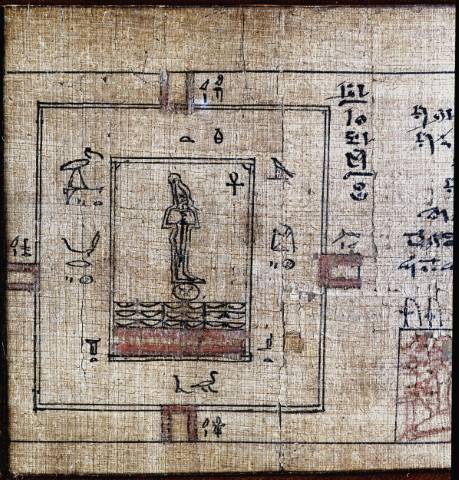
The Papyrus Salt 825, which is part of the British Museum’s collection and one of the few texts that refer directly to the House of Life, contains a description of the ritual for the “maintenance of life in the world” and the “protection of the image of Osiris from his rebels”. The ritual is believed to have been performed to ensure the continued existence and well-being of the cosmos and intended to be performed by a “scribe of the chamber which is called the House of Life.” This papyrus provides significant insights into the practices and beliefs of the House of Life and is rich in symbolism. For example, it describes the House of Life as a microcosm of the universe, with its walls representing the deities Isis, Nephthys, Horus and Thoth and its ceiling and floor representing heaven (Nut) and earth (Geb).
House of Life
This drawing of a vignette from Papyrus Salt 825 depicts an idealized version of the House of Life, with Osiris in the centre, protected on all sides by Isis, Nephthys, Horus, Thoth, Geb, and Nut. The illustration emphasizes the role of the institution as an Osirian cult place. Image: after A. Gardiner (1938) ‘The House of Life’, in Journal of Egyptian Archaeology 24: 169
There is no doubt that Egypt left an enormous legacy and should rightfully be called the ‘cradle of Western Civilization’ together with Greece and Rome. It was a culture that combined science, spirituality, art and governance in ways that profoundly influenced the ancient world and continue to resonate today. Its integrated model of holistic education in the Houses of Life could once again inspire us and help us reconnect with elements that we seem to have lost over the last two millennia.
I would like to conclude with a quote from the philosopher and cultural historian Jeremy Naydler, taken from the preface to his book Temple of the Cosmos. The Ancient Egyptian Experience of the Sacred:
Egypt calls to us like a lost part of ourselves. As we strive to achieve a new sensitivity toward the spiritual powers that pervade our lives, Egypt comes increasingly into focus for us. We find that there is a new and lively dialogue between the unfolding spirituality of modern times and that of the ancient, pre-Greek and pre-Judaic world. [….] For this reason, it is of inestimable value to pursue this dialogue with the ancient Egyptians. For although their era has now passed, they can nevertheless become our companions and guides as we venture toward our own future.
If any images used in this article are in violation of a copyright, please get in touch with [email protected] as soon as possible. Appropriate action will be taken.
Image References
Image - House of Life © The Trustees of the British Museum. Shared under a Creative Commons Attribution-NonCommercial-ShareAlike 4.0 International (CC BY-NC-SA 4.0) licence.
Permissions required for the publishing of this article have been obtained
What do you think?