The Goddesses of Philae Temple: Egyptian Art as a ‘Magical Machine’.
Article By Sian Phillips
 Egypt. Say the name and a host of iconic images are brought forth in your mind’s eye: The Great Pyramids, The Sphinx, King Tutankhamun’s funeral mask, walls filled with hieroglyphs, to name but a few.
All of these could be seen as expressions of Egyptian art and architecture, but really, they seem to go far beyond our modern conception of such things. For the Egyptians, art was always at the service of something far deeper, a ‘magical machine’ that influenced and affected the world. Beyond a mere expression of faith, art is a living, active, thing designed to cultivate and maintain life itself.
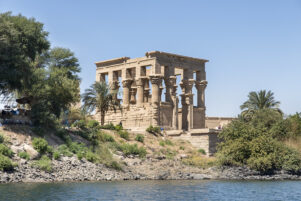
Visiting Egypt today gives ample opportunity to observe this, particularly in the surviving temple complexes. One specific example is the Philae Temple at Aswan. Philae, like many of the remaining Ancient Egyptian sites, is dated to the Ptolemaic period of Egyptian history, when the Greeks ruled Egypt following the conquest by Alexander the Great in 332 BC. The Ptolemaic pharaohs respected Egyptian culture, and the temples built during their reign still hold many of the ancient ideas and beliefs of the previous Egyptian dynasties. In fact, Philae was still in use well into the 4th century AD.
The main temple at Philae is dedicated to the goddess Isis, sister-wife of the god Osiris and mother of Horus. The depiction of Isis as a nurturing and maternal figure is easy for us to relate to, even across the span of over 2000 years. It can be seen very starkly at Philae in the decoration of the walls of the Mammisi (birth house), whose relief carvings illustrate the conception and birth of Horus. It is easy to associate these images with those of the Virgin Mary and Jesus in later Christian art.
This vision of the calm and nurturing side of the divine feminine continues elsewhere in the temple. The Inner Sanctum would have held the cult statue of Isis. As is typical for Egyptian temples, there are two chapels, one on either side of the sanctum, creating a trinity. The chapel on the left side continues with the depiction of the serene and fecund feminine with a depiction of Isis as Hathor. The two goddesses are often shown in a similar fashion, with a horned headdress holding a sun disk. Hathor is the goddess of joy, love, beauty, motherhood, and music, so it is easy to see how she fits in with the depiction of Isis as the divine mother.
Different facets of the divine feminine are shown in the chapel to the right of the inner sanctum. Here we see the fierce, aggressive and active side of the goddesses. There is Sekhmet, the lion headed goddess, known as both a destructive force, a goddess of war, and as a goddess of healing, a bringer of both life and death. She is shown being placated by the sounds of the sistrum – a sacred rattle – calming her destructive rage and restoring her to a state of peace. Thus the world is brought into harmony – a destructive force turned into a protective one. As if to emphasise this point, also shown in the chapel is Wadjet, the cobra headed goddess. She is a protective and vigilant force, thought to have helped defend the child Horus from his uncle, the god Set.
All the goddesses in both chapels are being presented with offerings, and the life of the temple would have revolved around daily rituals. The question then arises: what function does all of this have? This is where thinking of the temple (and the art contained within it) as a ‘magical machine’ can be helpful. The different facets of the divine feminine work together like a machine to produce a particular effect. There is the life-giving, generative forces of the nurturing and mothering goddesses, but what is produced also needs protecting and defending in order for the process to continue. It is this active quality that supports life, a continual regeneration – something that is central to the worldview of the ancient Egyptians.
Of course, this is just a small part of a much larger ‘machine’. The whole temple complex, from the site it is built on, the orientation of the buildings, to the stone used to construct it and the imagery shown on its walls – everything is designed to produce a very specific effect. Nothing is by chance. This is all part of the enduring mystery and appeal of ancient Egypt.
Image Credits: By kairoinfo4u | Flickr | CC BY-NC-SA 2.0
Related posts:
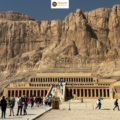
Image References
Featured Image : By kairoinfo4u | Flickr | CC BY-NC-SA 2.0
Permissions required for the publishing of this article have been obtained
What do you think?