Simone Weil: Attention, Compassion and the Power of Force
Article By Julian Powe
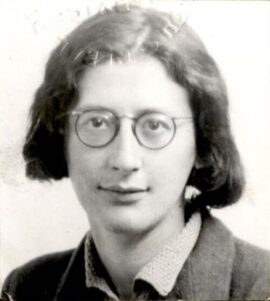 “A philosopher and interested in humanity” were among Simone Weil’s last words, responding to her doctor’s inquiry about who she was and what she did for a living. She had been laid low in Ashford sanatorium in England by her exhausting efforts in service of de Gaulle’s Free French, her tuberculosis, her history of poor health and her commitment to eat no more than the 900-calorie ration in occupied France. Weil died of heart failure on 24 August 1943, aged 34, and is buried in Ashford cemetery. To the consternation of her biographers, the local coroner concluded that she “slayed herself”. Richard Rees writes: “As for her death, whatever explanation one may give it will amount in the end to saying she died of love.”[1]
As in death, so in life. Simone Weil’s vigorous, uncompromising and radically compassionate engagement with the world arced through a Europe riven by economic dislocation, polarisation, the rise of totalitarianism and two world wars. In her French childhood, Weil joined protest marches and organised labour activities; in early adulthood, she came first in the prestigious entrance exams for the Ecole Normale Supérieure (Simone de Beauvoir came second), and throughout her life her extraordinary intelligence kept close company with the philosophers, writers, mathematicians and historians of ancient and modern times; she taught in three lycées, often a thorn in the side of their administration, and formed the habit of teaching in workers’ night schools; having told her pupils “I need to engage the real world”, she worked on the production line in several factories, lived and worked on farms and went to sea on trawlers; she joined an anarchist column in the Spanish Civil War; and as global conflict enveloped the world, she settled her parents in New York and made her way to the Free French in London. She was loved and admired by many she encountered (a very few felt patronized), and enjoyed a tender rapport with her parents, with no evidence of any other personal, intimate relationship. One of her French resistance comrades in Marseille, the poet Jean Tortel, found Weil to be “rather formidable, and fearsome…Through her glasses, she looked at you (when she did look)…with an intensity and, also, a kind of inquisitive greediness that I have never experienced with others…[her gaze] was nearly insupportable. In her presence, lies were simply excluded.”
Weil’s ‘Vita Contemplativa’ and ‘Vita Activa’ were symbiotically connected. As she thought, so she acted; as she acted, so she thought. She wrote constantly in her journals with a surge in the Second World War (90% of them were written between 1940 and 1943); covering pages in Sanskrit, Greek, Latin, mathematical equations and geometrical diagrams; tearing out and rearranging pages; reflecting on what she was attending to; exhorting self (“Never surrender to the flow of time!”), and only very rarely referring to private events and feelings. “There is probably not a single fundamental problem of our age, in any domain, that is not resolutely faced and examined somewhere in these pages.” (Richard Rees). Having published rarely in her lifetime, the main body of her work reached the world posthumously. 800 pages of her notes and policy proposals found their way to Albert Camus who, at the end of the war, became editor of Gallimard. In contact with Weil’s mother, Selma, he published several of her works under the label L’Espoir (Hope).
In accepting the Nobel Prize in Literature in 1957, Camus named Weil as one of two primary influences. He described her as “The only great spirit of our time… Her life and philosophy were one and the same… She held to uncompromising ethical commitments… Frivolity was the only thing of which she was incapable.” A recent biographer, Robert Zaretsky, places her firmly in the classical tradition of philosophy, taking her models of development and growth from the Hellenistic schools. He captures beautifully the multi-faceted and paradoxical constellation of Weil’s contributions in her short life – “An anarchist who espoused conservative ideals, a pacifist who fought in the Spanish Civil War, a saint who refused baptism, a mystic who was a labour militant, a French Jew who was buried in the Catholic section of an English cemetery, a teacher who dismissed the importance of solving a problem, the most wilful of individuals who advocated the extinction of the self: here are but a few of her paradoxes… She was convincing but subversive, eloquent yet abrasive, and practical yet persuasive.”[2] And in The Long History of Heroism, Rory Stewart[3] called Weil “One of my genuine heroes… A towering intellect allied with her radical compassion, fierce integrity and spiritual depth. She lived every moment as if truth and justice were the most urgent matters of her soul.” Indeed, Simone Weil carries the character of a modern-day Antigone.
Emanating from the torn humanity of the 1930s and 1940s, Weil’s philosophy inspires our own search for renewal in our challenged 2020s – in her framing of ‘attention’, in her strident warnings about untethered power, in her advocacy of rootedness and our obligations to each other, and in the example she set of her philosophy in action.
One of Simone Weil’s lycée students in Roanne, Anne Reynaud, described how she took her class outdoors to sit under a tall tree “not to find the answer but to seek problems in geometry”. In her writings and her standing in the thick of the world, Weil developed a very expansive approach to ‘attention’, not the muscular, scrutinising exercise of controlled body language and eye contact, but a kind of letting go, opening oneself up to another person or to a problem, allowing the object of our attention to enter us, to manifest its complexity and to become the subject of contemplation over time (and perhaps never to be ‘solved’; for Weil, the effort and the strengthening of the habit of attention was more important than the end result). She urges relentless attachment to the truth – “Refuse to be an accomplice. Don’t lie – don’t keep your eyes shut.” And she guides us away from the self towards deep acknowledgement and respect of the other, “to see others as they are related to themselves, and not to me”, peering through and beyond the meanings and projections we lazily attribute to our environment, “to contemplate what cannot be contemplated (the affliction of the other) without running away and to contemplate the desirable without approaching – that which is beautiful”.[4]
Do we not hear echoes of Immanuel Kant’s notion of reverence, ‘Achtung’, being bowled over by the embodiment of moral law in another human being; of Martin Buber’s advocacy of I-Thou not I-It, offering us the rich possibility of deep communion with the other; and of the Gestalt theorists’ frame of patiently and attentively waiting for the ‘figure’ to emerge from the ‘ground’? And do we not hear guidance on how we might all attend more effectively to the complexity of our 21st century world in Weil’s beautiful exposition of how to hold oneself and our preciously acquired knowledge in respectful abeyance, to slow our thinking down?
Weil opens The Iliad, or The Poem of Force in typically trenchant style (for Zarestsky, she does not ‘argue’, she ‘posits’) – “The true hero, the true subject, the centre of the Iliad is force. Force employed by man, force that enslaves man, force before which man’s flesh shrinks away.”
After completing in 1940, with her parents and several million people, the exodus from northern France and Belgium, reaching Marseille in the French free zone and connecting with local resistance groups, Weil turns to her beloved Iliad to reflect on the eternal nature of ‘force’, under the anagrammatic pseudonym of Emile Novis (antisemitic rules now forbade any publications by Jewish people; and we should not forget that Weil was questioned by the police at this time). For Weil, ‘force’ is present in all our lives, it controls us, even though we sometimes believe that we control it.
…Force is as pitiless to the man who possesses it, or thinks he does, as it is to its victims; the second it crushes, the first it intoxicates. The truth is nobody really possesses it…
…The preservation of power is a vital necessity for the powerful, since it is their power that provides their sustenance.[5]
Such a rich parable for our current times, assailed as we are by frequent examples of brutal force, untethered by moral anchors and a sense of compassionate duty to others. Weil, of course, does not just see ‘force’ expressed on the battlefield, albeit a metaphor for the affairs of man. She bears witness to it in the economic spheres in which she stands, a sense of affliction (‘la malheur’) that robs her and her fellow workers of the essence of being human, the capacity to think – “The effect of exhaustion makes it almost impossible for me to overcome the strongest temptation that this life entails; that of not thinking any more, which is the one and only way of not suffering from it”.
In her work on regeneration and renewal, and independent thinker that she was in the 1930s and early 1940s, Weil abhors the moves to the totalitarianism of the right and left and eschews the notion of revolution; on the grounds that it produces new and even more oppressive hierarchies of power. “The word ‘revolution’ is a word for which you kill, for which you die, for which you send the labouring masses to their death, but which does not possess any content.”
Instead, she turned to remedies for the up-rootedness she saw all around her – in industrialisation, in colonialism, in mass deportations; explaining for her the sudden defeat of France in 1940 (“A tree whose roots are almost entirely eaten away falls at the first blow.”). Weil advocated re-connection with our roots – with a community’s deeply engrained way of life; with a sense of partnership between the living, the dead and those to be born; with the treasures and imperfections of culture and history; with education, to root in the individual the capacity fundamentally to change their lives; with a profound sense of obligation and duty towards each other; with our very soul.
The Need for Roots was Weil’s 1942-43 oeuvre in response to the Free French question about how to regenerate France after the war. Its sub-title is Prelude to a Declaration of Obligations towards the Human Being. She grounds her advocacy of rootedness in an exposition of meeting the needs of the soul (liberty, freedom of opinion, honour are among the fourteen needs she identifies) – “Duty toward the human being as such – that is eternal.” And she jumps in her first sentences into an attachment to the primacy of obligations over rights – this in the decade of the Universal Declaration of Human Rights (1948) – aligning herself with the notion of a human self ‘embedded’ in a web of social and spiritual obligations and duties, as opposed to an ‘inviolable’ self, prone to definition in differentiation to others.
The concept of obligations takes precedence over that of rights, which are subordinate and relative to it. A right is not effective on its own, but solely in relation to the obligation to which it corresponds.[6]
Weil’s champion, Albert Camus, channels this sense of obligation and duty through the character of Doctor Rieux in The Plague (1947). The doctor’s courageous moral obligation is to reject resignation in favour of communal defiance of pestilence, real and metaphorical – “The thing was to do your job as it should be done…It is a matter of common decency. That’s an idea that might make some people smile but the only way of fighting a plague is – common decency… A fight must be put up and there must be no bowing down.” [7]
Camus and Rieux were both atheists. By the end of her life, Simone Weil carried a profound faith in God. She had several mystical experiences in her life and during her time in Marseille held transformative conversations and correspondence with Father Perrin, a priest and resistance activist, resulting in her Waiting on God[8].Zaretsky describes her relationship with God as complex and “punishing.” At its core is the notion of ‘decreation’. Just as God has expressed love for humanity by folding in on himself to allow the world to be created, so should human beings decreate themselves to allow God to return to the world. Iris Murdoch, a great admirer of Weil, transmutes this into the challenging idea of “unselfing”, “dethronement of the self”, reducing the constraints of our “fat, relentless ego”, to make space for unencumbered attention to others and to meet Weil’s exhortation to truly “attend to the world as it is.”
Simone Weil is often described as a ‘saint’ and a ‘hero’, labels she would certainly have disdained in her horror of our addiction to telling fine stories about ourselves. There is much of the ‘saintly hero’ in her life and work – sacrifice, negation of the self in compassionate service of others, a stretching of human possibilities, a sense of noble purpose, a legacy. And her presence inspires a mix of personal discomfort and aspiration – for Zaretsky, “both revelation and reproach”; for Iris Murdoch, a sense of high standards; for me, a determination to be more actively compassionate in the world, whilst embracing the glories of this terrestrial life a little while longer!
There is another paradox about Simone Weil. Albeit with the tender support of her parents, and the admiration of many, she conducted herself mainly in tenacious solitude; and yet, her message to us is primarily about connection, community, compassion and a collective, rooted consciousness embracing all of humanity – at a level that seems way beyond us at present. Camus might have been right to call Weil “the only great spirit of our time”. But perhaps she is also a great spirit of some future time, heralding a path towards a collective consciousness that has love and wisdom truly at its core.
[Compassion]… is able, without hindrance, to cross frontiers, extend itself over all countries in misfortune, all countries without exception; for all peoples are subject to the wretchedness of our human condition. (The Need for Roots)
Further reading:
Miles, Sian. (Ed.) Simone Weil: An Anthology (Penguin Classics, 2005)
Eilenberger, Wolfram. The Visionaries: Arendt, Beauvoir, Rand, Weil and the Salvation of Philosophy (Allen Lane, 2023)
Image Credits: By Wikimedia Commons | CC BY PD
Related posts:


Permissions required for the publishing of this article have been obtained
Article References
[1] Rees, R. Simone Weil: A Sketch for a Portrait (Southern Illinois Press, 1966) [2] Zaretsky, R. The Subversive Simone Weil: A Life in Five Ideas (University of Chicago Press, 2021) [3] Stewart, R. The Long History of Heroism, Episode 3 (BBC Sounds, 2025) [4] Weil. S. (Tr. Ed. Rees, R.) First and Last Notebooks (Oxford University Press, 1970) [5] Weil, S. The Iliad, or the Poem of Force (Pendle Hill Pamphlets, 2025. First published in 1940) [6] The Need for Roots: Prelude to a Declaration of Obligations towards the Human Being (Penguin Classics, 2023. First published in 1949) [7] Camus, A. The Plague (Penguin Modern Classics, 2002. First published in 1947) [8] Weil, S. Waiting on God (Harper Perennial Classics, 2009. First published in 1950)
What do you think?