Romanticism or Realism?
Article By Julian Scott
 This question occurred to me as I was coming to the end of the 19th century novel Middlemarch by George Eliot (the pseudonym of Mary Ann Evans). As the characters’ lives and actions came to fruition I found myself thinking: would this person’s life really have ended like this (so happily), or would they have ended up in a pit of despair? Not that they all ended up living ‘happily ever after’, but the worst that could have happened did not generally happen, because a benevolent fortune, fate or destiny (via the writer) intervened. Whereas in the works of other novelists, such as Thomas Hardy, I would find myself thinking, ‘this can’t get any worse’… and it generally did.
So although Middlemarch is not classified as a strictly romantic novel, as there are many realistic elements of everyday life in a provincial English town, it is not so gritty as, say, a novel by the French writer Émile Zola, author of such grim works as Thérèse Raquin – about a wife who, with her lover, plots to murder her disabled husband – or Germinal, which highlights the misery of working in a 19th century mine.
Tastes differ, but I would venture to assert that a novel like Middlemarch leaves you feeling more uplifted and optimistic, whereas those of Hardy or Zola are likely to leave you feeling rather depressed. What is better for the human being? There might be several ways of answering this question. Is the role of art to uplift, or to reflect ‘reality’? And I put ‘reality’ in inverted commas, because reality is actually quite subjective. Yes, conditions in a 19th century mine were no doubt horrific. But there were other things going on in the 19th century which were very positive (all the amazing classical music for example). So the reality of the 19th century is all of those things, not just the bad things (or the good things).
Rather than enter into a literary debate on this point, I would like to look at it through the lens of mythology. Do myths always have a happy ending? Indeed, do fairy tales, which are a form of mythology, always end happily? Generally, yes, but that ending may be a very long time coming, and may not even take place in this world, but in heaven!
Let us look at some examples: The Odyssey by Homer, for instance. Odysseus travels back to his island home on Ithaca, where he is reunited with his wife and son. A happy ending indeed, but the journey takes ten years and during that journey, the hundreds of companions who accompanied him died, often in the most horrific manner, such as being eaten alive by the pitiless one-eyed Cyclops.
The same could be said of the story of Heracles and his Twelve Labours. In the end he was successful, but in one of the fits of madness sent to him by the Goddess Hera, he kills his wife and children, and afterwards, obviously, is filled with horror and remorse.
Or we can take the most tragic of all Greek tragedies, that of Oedipus, who famously kills his father (unwittingly), marries his mother (without realizing it) and blinds himself in shame for his actions, which were not really his fault. But finally he ascends to heaven, where a voice greets him kindly, saying, ‘what took you so long to return?’ So even that gory myth ends happily for Oedipus.
A similar destiny awaits Orpheus and Eurydice, the doomed lovers, Eurydice being condemned to return to the Underworld and Orpheus being torn to pieces by the raging Maenads (female followers of Dionysus). But in the end, both of them ascend to heaven and are happily reunited in the constellation of the Lyre.
I would say that these mythical stories are actually more true to life than either the romantic or realistic novels, because they reveal a much more long-term vision, in which happiness comes in the end, but not necessarily in this world. However, in these myths, the focus is not so much on happiness, as on meaning. In the Odyssey the meaning is that in order to attain real happiness, one must pass through many trials, understanding a trial not merely as a phase of suffering, but as a way of learning and also of divesting oneself of parts of oneself that one has outlived and no longer needs.
It may come as a surprise to many that myths are a form of philosophy, as the archaeologist and anthropologist Henri Frankfort eloquently put it: “Myth is a carefully chosen cloak for abstract thought.” If we follow this golden thread, we can extract many wonderful teachings from ancient myths. But how can we apply all this to life?
In life, we shouldn’t expect a happy-ever-after ending, because “happiness is not a plant of this world”, as Delia S. Guzmán writes in one of her books. Rather, happiness comes after a long journey of resolving all the problems we have within ourselves, and this is done by seeing them not as problems, but as trials which will help us to grow.
The romantic attitude is good in that it contains ideals: ideals that are expressed in people with strong values or virtues, such as selflessness and generosity, as contrasted with self-interest, pettiness and meanness. The realistic attitude is also good in that it focuses on the stark injustices of the world and makes us more aware of them. If you like, it brings us down to earth. But as the human being is made of both heaven and earth, spirit and matter, surely true realism must also contain idealism and a touch of romanticism?
Moreover, it is probably not realistic to assume that everyone has feet of clay and that, as Plato suggested, it is possible to emerge from the Cave of illusion, and to ascend towards perfect justice, even if in this world nothing is absolutely perfect. But a Buddha, a Jesus, and quite a few others, have come pretty close.
The heroes of the myths are not perfect either – they make mistakes and often suffer from hubris – but they are somehow ‘great’ (often depicted as the children of some god) in their strength and intelligence; and this greatness of spirit enables them to overcome all the trials, which in the end make them more humble and benevolent as human beings, and above all wise. This is why Heracles is shown in the end being carried up to heaven in a chariot driven by Athena, the goddess of wisdom.
Because it is wisdom which is the true goal of the journey, and all these stories, whether in myths or great novels, enable us to gather some seeds of wisdom that will help us arrive at that sunny harbour. And, as Plato shows in Book IX of his Republic, it is only through wisdom and justice that true and lasting happiness can be achieved.
Image Credits: BY National Portrait Gallery: NPG 1405 |Wikimedia Commons | CC BY PD
Related posts:
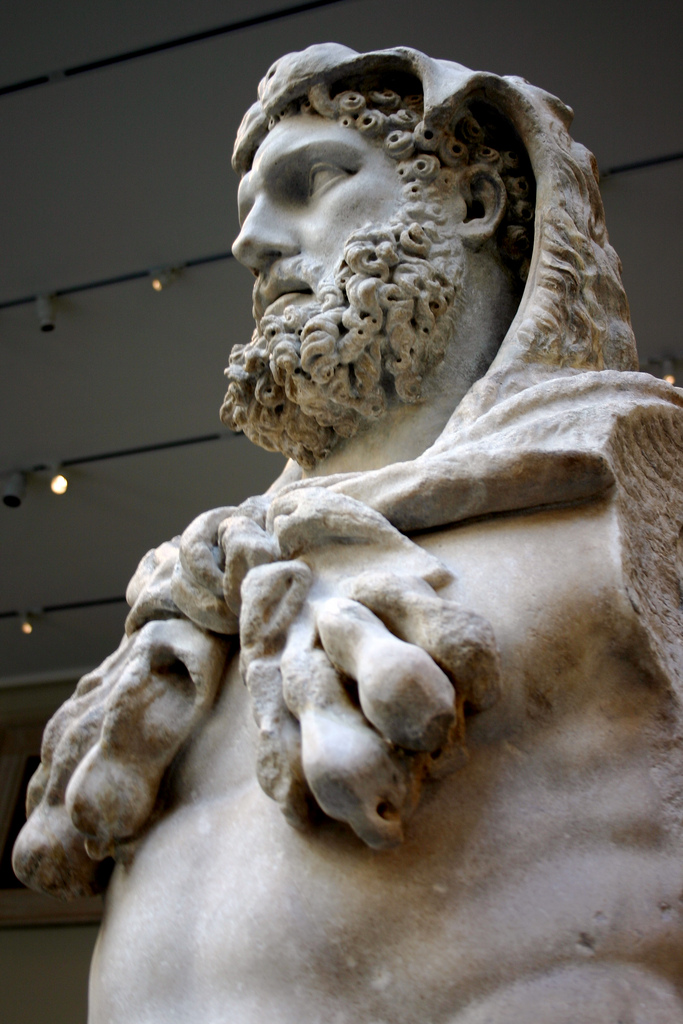
Image References
BY National Portrait Gallery: NPG 1405 |Wikimedia Commons | CC BY PD
Permissions required for the publishing of this article have been obtained
What do you think?